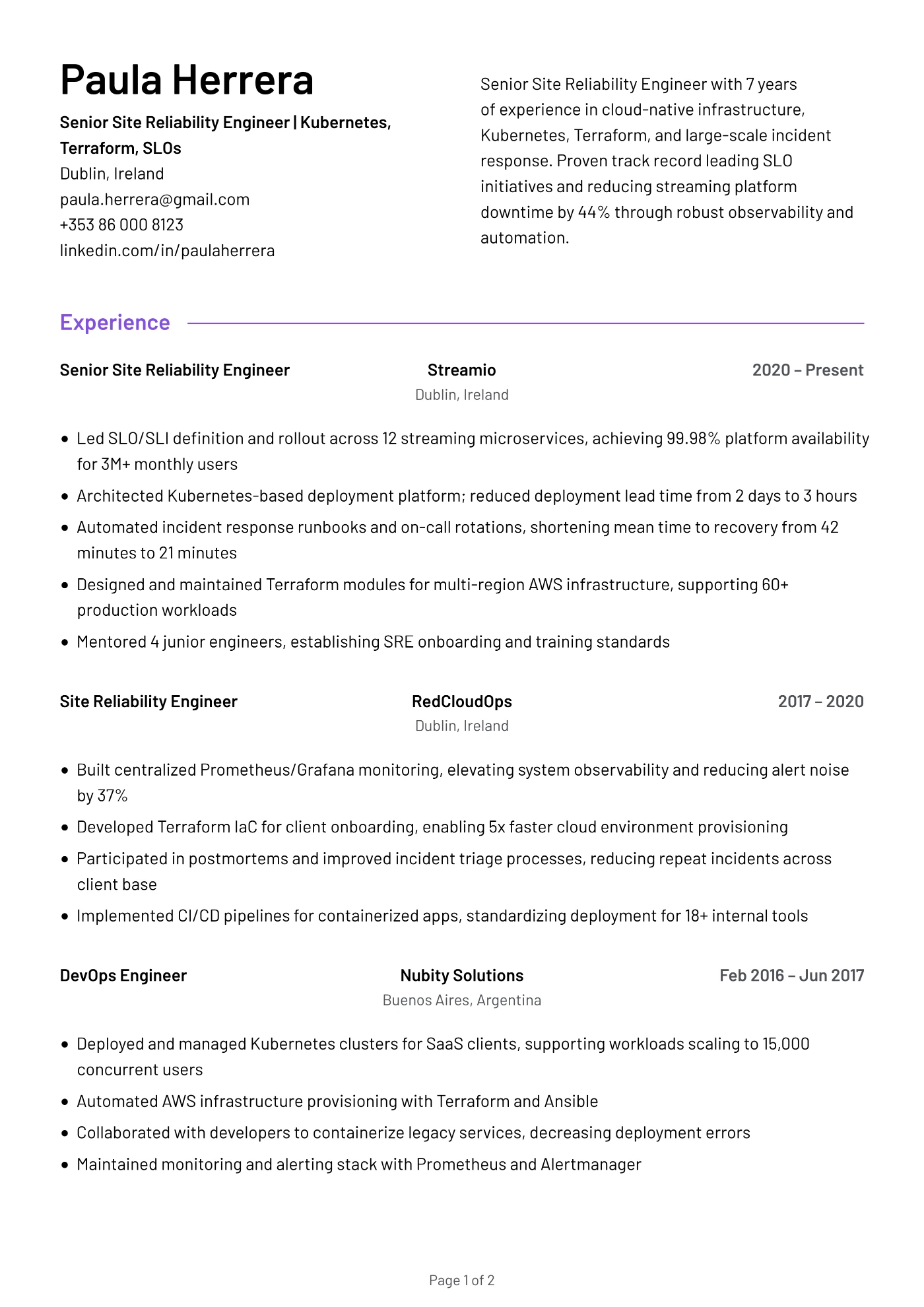
Senior Site Reliability Engineer Resume Example
A senior SRE resume example with deep Kubernetes and incident response expertise. Ideal for high-scale streaming, cloud, or platform engineering roles.
Why this works
- Impact-first bullets with clear reliability metrics
- Evidence of SLO ownership and incident leadership
- Breadth across cloud, automation, and observability
- Mentoring and process improvement experience
- Stack and role alignment for streaming platforms
Senior Site Reliability Engineer Resume: full text
Summary
Senior Site Reliability Engineer with 7 years of experience in cloud-native infrastructure, Kubernetes, Terraform, and large-scale incident response. Proven track record leading SLO initiatives and reducing streaming platform downtime by 44% through robust observability and automation.
Experience
Senior Site Reliability Engineer
Streamio, Dublin, Ireland · 2020 – Present
- Led SLO/SLI definition and rollout across 12 streaming microservices, achieving 99.98% platform availability for 3M+ monthly users
- Architected Kubernetes-based deployment platform; reduced deployment lead time from 2 days to 3 hours
- Automated incident response runbooks and on-call rotations, shortening mean time to recovery from 42 minutes to 21 minutes
- Designed and maintained Terraform modules for multi-region AWS infrastructure, supporting 60+ production workloads
- Mentored 4 junior engineers, establishing SRE onboarding and training standards
Site Reliability Engineer
RedCloudOps, Dublin, Ireland · 2017 – 2020
- Built centralized Prometheus/Grafana monitoring, elevating system observability and reducing alert noise by 37%
- Developed Terraform IaC for client onboarding, enabling 5x faster cloud environment provisioning
- Participated in postmortems and improved incident triage processes, reducing repeat incidents across client base
- Implemented CI/CD pipelines for containerized apps, standardizing deployment for 18+ internal tools
DevOps Engineer
Nubity Solutions, Buenos Aires, Argentina · Feb 2016 – Jun 2017
- Deployed and managed Kubernetes clusters for SaaS clients, supporting workloads scaling to 15,000 concurrent users
- Automated AWS infrastructure provisioning with Terraform and Ansible
- Collaborated with developers to containerize legacy services, decreasing deployment errors
- Maintained monitoring and alerting stack with Prometheus and Alertmanager
Skills
Cloud & Infrastructure
AWS (EKS, EC2, S3, IAM), Terraform, Kubernetes, Helm
Observability
Prometheus, Grafana, Alertmanager, Sentry
Automation & CI/CD
GitHub Actions, Jenkins, ArgoCD, Ansible
Incident Response & Reliability
SLO/SLA definition, On-call management, Postmortem facilitation
Languages
Python, Go, Bash
Education
BSc Computer Engineering
Universidad de Buenos Aires · 2011 – 2015
Specialization in Distributed Systems and Cloud Computing
How to write a senior site reliability engineer resume
A strong senior site reliability engineer (SRE) resume should highlight your leadership in designing, scaling, and maintaining resilient infrastructure on cloud platforms such as AWS, as well as your expertise in automation and incident response. At this level, hiring managers seek evidence of driving reliability initiatives, mentoring peers, and making measurable improvements in system uptime, deployment pipelines, and observability.
Structure your resume to emphasize technical depth and real-world impact. Prioritize your experience with tools like Kubernetes, Terraform, and Prometheus, and quantify your achievements (e.g., reduction in downtime, deployment lead time, or alert noise). Use active, specific language to demonstrate ownership of critical projects, collaboration with engineering teams, and experience leading SRE practices.
What skills should a site reliability engineer put on a resume?
Site reliability engineers at the senior level need a balance of infrastructure automation, observability, incident management, and leadership. Highlight expertise in core SRE tooling, cloud services, and programming, as well as your ability to drive reliability and mentor others.
- Cloud infrastructure: AWS (EKS, EC2, S3, IAM), Kubernetes, Terraform, Helm
- Observability & monitoring: Prometheus, Grafana, Alertmanager, Sentry
- CI/CD & automation: GitHub Actions, Jenkins, ArgoCD, Ansible
- Incident management: SLO/SLA definition, on-call management, postmortem facilitation
- Programming & scripting: Python, Go, Bash
- Team leadership: mentoring, onboarding, best practices development
Site reliability engineer resume bullet point examples
Strong resume bullets for senior SREs showcase technical leadership, automation, and measurable improvements in reliability and scale. Use specific before-and-after numbers, scale of systems, and leadership in process or technical change.
- Implemented proactive monitoring dashboards, cutting false positive alerts from 120/week to 30/week across production clusters.
- Migrated legacy CI/CD workflows to ArgoCD, reducing average deployment rollbacks from 15 per month to 3.
- Scaled managed Kubernetes environment to handle traffic spikes up to 25,000 concurrent sessions without service degradation.
- Developed and maintained Terraform modules supporting cross-region failover for 80+ workloads.
- Led SRE knowledge-sharing sessions, creating standardized runbooks that improved team onboarding and reduced incident response variance.
Common mistakes on site reliability engineer resumes
Senior SRE applicants often make mistakes by missing critical context, impact, or technical detail. Avoid these pitfalls to stand out for advanced roles.
- Listing tools without showing impact—always tie skills to reliability or performance outcomes.
- Focusing only on operations—include project ownership, automation, and infrastructure-as-code achievements.
- Neglecting leadership—show mentorship, training, or process creation, not just technical skills.
- Using vague terms like 'improved reliability'—quantify results with availability, response time, or reduction metrics.
Frequently asked questions
How long should a senior site reliability engineer resume be?
Two pages is ideal for senior SREs with 7+ years’ experience. Prioritize recent, relevant projects, especially those with measurable impact or leadership involvement. Avoid listing every technology; focus on your strongest contributions and the tools you used to achieve them.
Should senior SREs include certifications or side projects?
Include certifications (e.g., AWS Certified Solutions Architect, CKA) if they are current and relevant to the stack. Side projects are valuable if they demonstrate advanced SRE skills or leadership, such as building an open-source monitoring tool or leading a reliability community.
How can I show leadership on an SRE resume?
Show leadership through examples of mentoring, onboarding programs, leading incident postmortems, or driving SLO adoption. Use bullet points that describe team impact, process improvements, or standardization efforts you led, not just individual technical achievements.
Which keywords matter most for senior SRE roles?
Keywords that align with the stack and responsibilities are essential: SLO, SLI, Kubernetes, Terraform, AWS, Prometheus, incident response, CI/CD, automation, and mentoring. Use these in both your skills and experience sections to help pass automated screening and show domain expertise.