How to show a promotion on a software engineer resume
· 7 min readTo show a promotion on a software engineer resume, write the company name once and stack each title beneath it, newest first, each with its own dates and its own bullets. The reader sees one employer, a clear step up, and what changed in your work at each level.
That covers the simple case. Many engineers have a harder one: the level changed but the title did not, the team lead role came without a promotion, or the promotion arrived three months before leaving. This post covers the format first and those cases after.
What is the best format for a promotion at the same company?
Stack the titles under a single company heading, most recent first. Put your total dates on the company line. Give every title its own line with its own date range, and put the bullets for that period directly under it.
Here is the format on a real page. This entry is from our senior frontend engineer example, where one person moves from junior to senior at a single company:
Cloudlytics, Bangalore | 2016 – Present
Senior Frontend Engineer | 2021 – Present
- Architected and implemented a design system in React and Storybook, reducing UI inconsistencies across 5 product teams
- Led a performance overhaul for the main dashboard, reducing initial load time by 55%
Frontend Engineer | 2018 – 2020
- Shipped 12+ new features in a Next.js SaaS platform serving 80k+ monthly users
- Refactored legacy JavaScript to TypeScript, increasing code coverage from 62% to 91%
Junior Frontend Developer | 2016 – 2018
- Developed and maintained React components for the customer onboarding flow
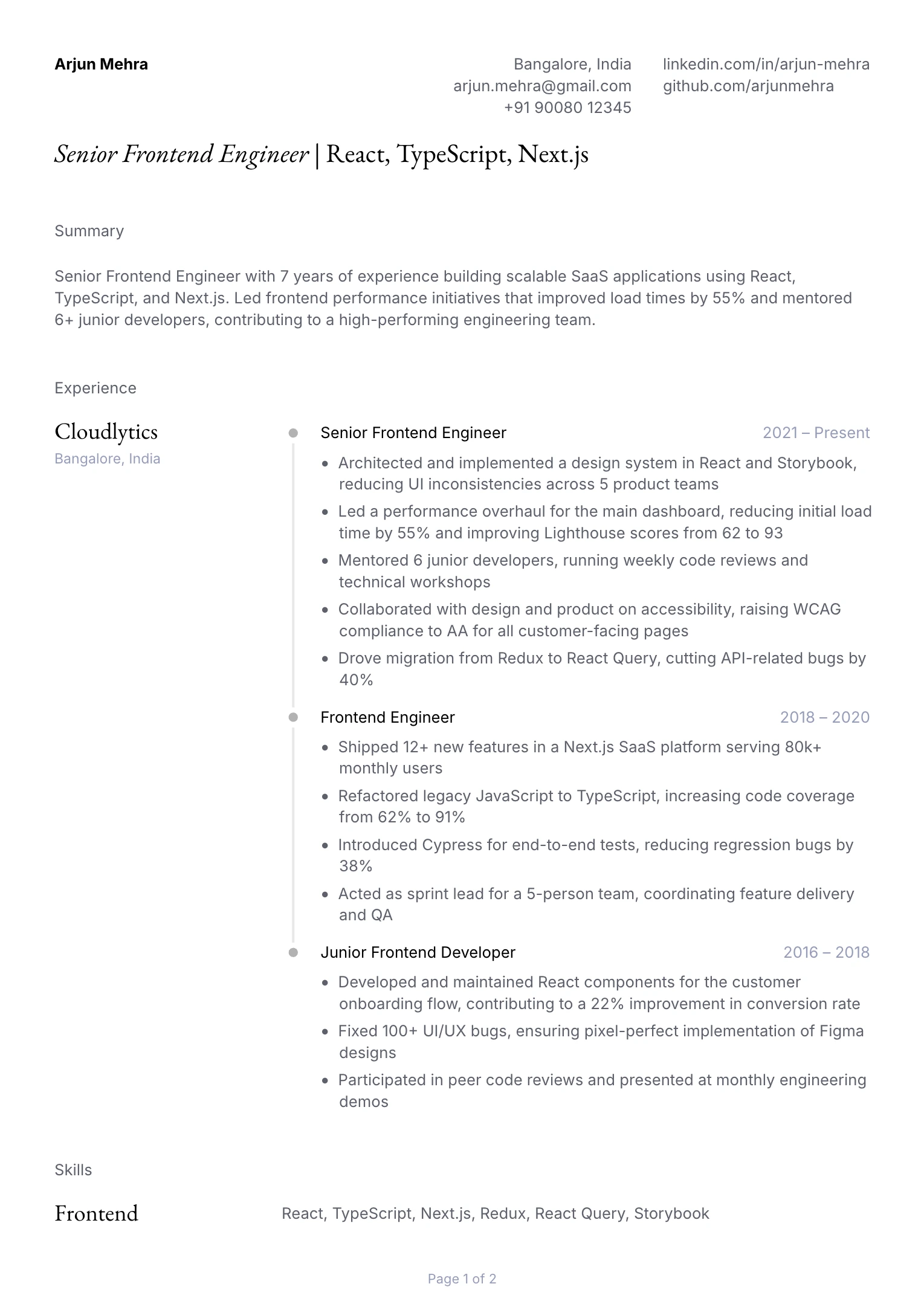
Senior Frontend Engineer Resume Example: Promotions at One Company
Three titles stacked under one company, each with its own dates and bullets.
View the full example
Compare that with the version many people start from, where the company is repeated as if it were three jobs:
Cloudlytics | Senior Frontend Engineer | 2021 – Present
Cloudlytics | Frontend Engineer | 2018 – 2020
Cloudlytics | Junior Frontend Developer | 2016 – 2018
The repeated version is not wrong, but it hides the promotions. A person scanning the list of employers counts three entries and has to compare the names to see that you stayed and moved up. In the stacked version the steps are visible at once, and the company line states your total time there.
Keep the layout plain so the text can be extracted cleanly: one title per line, the dates on the same line as the title, and ordinary characters. Avoid arrows, icons and a separate column for dates, because the reading order of the extracted text can differ from what you see on the page.
If you build your resume in Filiz, add each title as another role under the same company and the company is printed once with the roles beneath it.
When should you use separate entries instead?
Use separate entries only when there were two separate periods of employment. In practice that means two cases.
The first is leaving and coming back. The years in between belong to another employer, and a stacked block would hide them:
Tallis Digital, Manchester
Senior Software Engineer | Sep 2023 – Present
Halden Pay, Leeds
Software Engineer | Feb 2022 – Aug 2023
Tallis Digital, Manchester
Software Engineer | Jun 2019 – Jan 2022
The second is a move to a different legal employer in the same group, such as a subsidiary with its own name or an office in another country with a new contract. List them separately and say in a few words how they are related.
Everything else stays stacked under one company, including a change of discipline. A move from QA engineer to backend engineer, or from senior engineer to engineering manager, is still one employer who gave you a different job. Stacking shows that, and the two titles make the change obvious.
How do you make the bullets show growth?
Write each level's bullets about the largest thing you were trusted with at that level. A promotion in engineering is mostly a change in scope: from tasks, to features, to a system, to systems that belong to several teams. If the bullets under both titles describe work of the same size, the reader has no evidence that anything changed except the title.
A useful test is to read only the first bullet under each title. The two should describe clearly different sizes of responsibility.
Before:
Senior Software Engineer | Apr 2022 – Present
- Developed new features for the checkout flow using React and TypeScript
Software Engineer | Jun 2019 – Mar 2022
- Developed features for the checkout flow using React
After:
Senior Software Engineer | Apr 2022 – Present
- Led the checkout rebuild for web and mobile web: wrote the design doc, divided the work among four engineers, and shipped in two quarters
Software Engineer | Jun 2019 – Mar 2022
- Built the saved-cards and address-validation steps of the checkout in React, covered by Cypress tests
Do not repeat a bullet under two titles. If a project continued across the promotion, put it under the level where you had the most responsibility for it, and give the other level something else.
Older roles need fewer bullets. Four or five for your current level and two for a level you held five years ago is a normal shape.
What if your level changed but your title did not?
Many companies promote along an internal ladder. The title on your profile may stay "Software Engineer" while the level behind it changes, or it may change to something like "Software Engineer III" that only makes sense inside the company.
Level names do not translate between companies. The same number, and even the same title, can be a junior level at one company and a senior level at another. So write the official title, then add the level in plain words:
Software Engineer (senior level) | Jan 2023 – Present
Software Engineer (mid level) | Aug 2020 – Dec 2022
Keep the official title as the first thing in the entry. Employers often confirm job titles and dates when a new company checks your history, although what they confirm varies by country and by employer. Your offer letter or HR system shows the title on record, and that is the safest one to use. The cost is that a person scanning titles does not see the word "Senior" first. The note in parentheses is there to reduce that cost without changing the record.
Add the internal code, such as "L5" or "IC4", only when you apply to companies that use a similar ladder and will read it correctly.
How do you show a tech lead role that came without a new title?
Leading a team is often an assignment, not a promotion. Your title stays "Senior Software Engineer" and your work changes a great deal. If you leave the lead role out, the resume describes a smaller job than the one you do. If you replace your title with "Tech Lead", the resume may no longer match your employer's record.
Keep the official title and make the lead role the first bullet, with the date it started:
Senior Software Engineer | Feb 2021 – Present
- Tech lead of the six-engineer Payments team since Sep 2023: set the quarterly technical plan, run design reviews, and write code about half the time
- Automated retries for failed card payments, which removed a weekly manual task and recovered about 3% of failed charges
- Earlier: built the refunds API and its reconciliation job
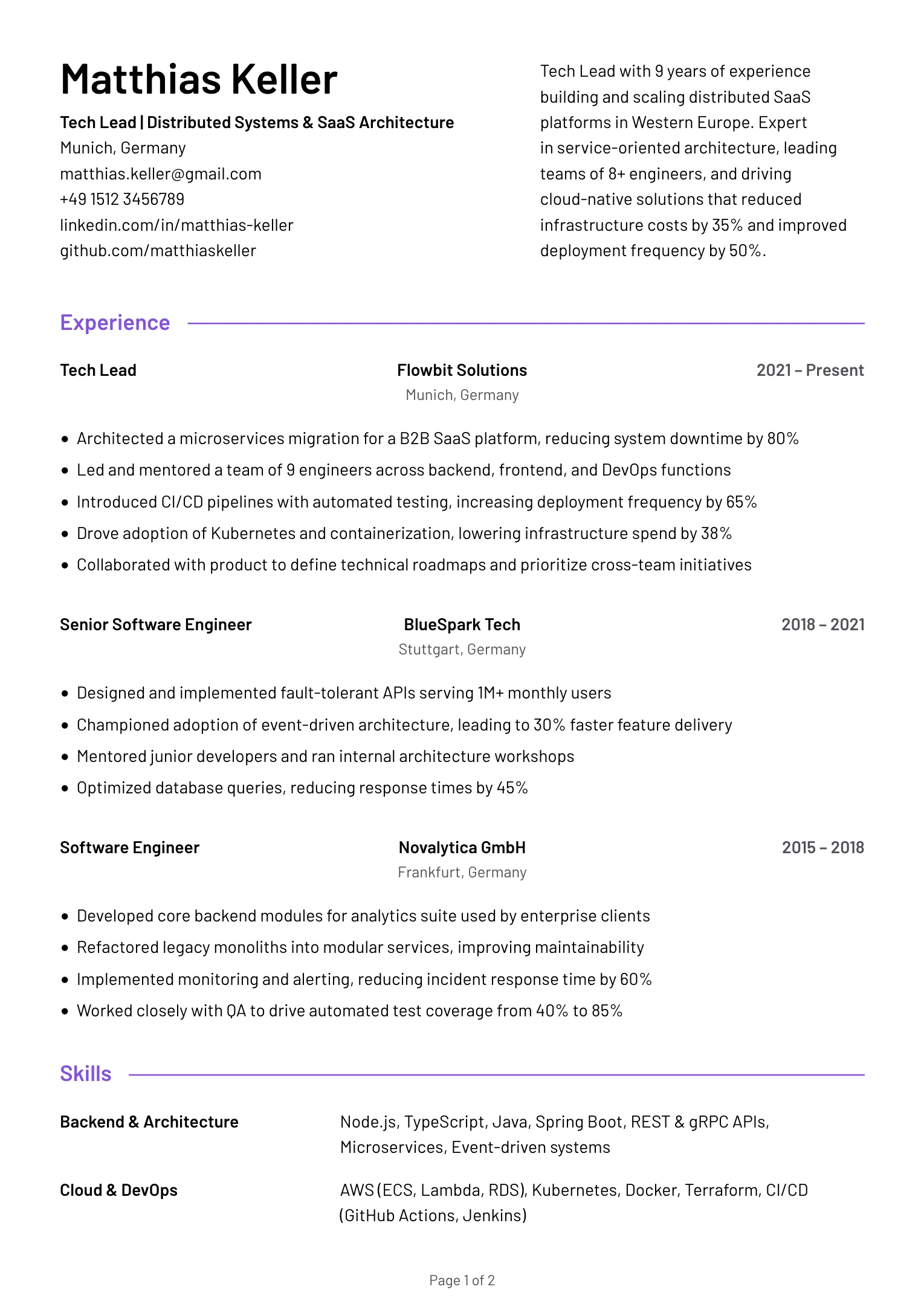
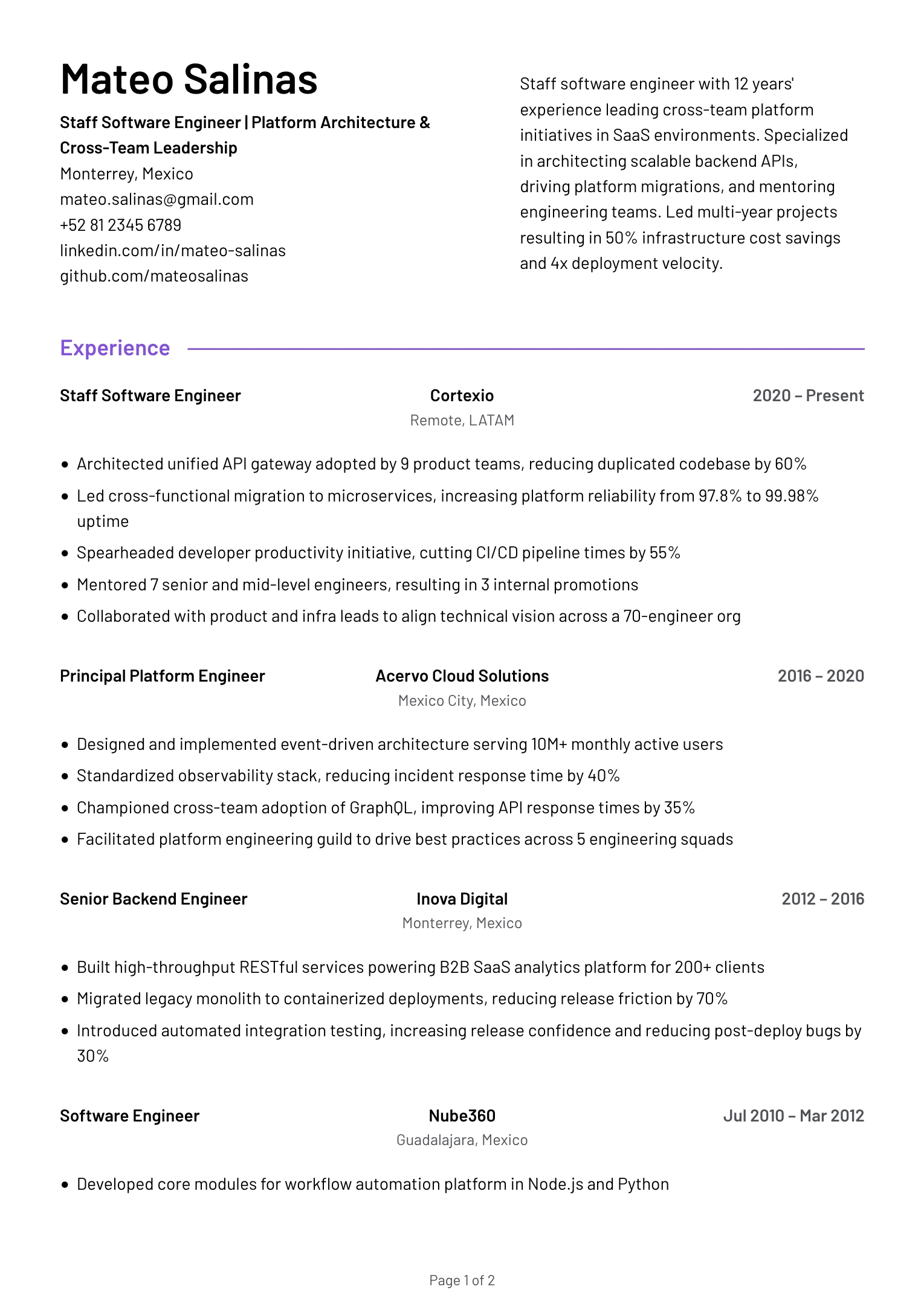
The evidence is the team size, what you decide, and what the team shipped. Our tech lead resume example shows bullets like these across a whole page, and the staff software engineer resume example does the same for work that crosses several teams.
What about the awkward cases?
Promoted shortly before leaving. List it with the real dates. Your employer decided you were working at that level, and that is worth showing. The company you apply to will still make its own decision about your level, and a short time at senior level may be questioned in interviews, so say what you took on:
Senior Software Engineer | Jan 2024 – Mar 2024
- Promoted after leading the search migration; took over on-call ownership of the search cluster
Software Engineer | May 2021 – Dec 2023
The title changed and the work did not. Combine the two titles in one entry with one set of bullets. Splitting identical work across two titles forces you to repeat yourself.
Senior Software Engineer (promoted Apr 2022; previously Software Engineer) | Jun 2019 – Present
The company was acquired or reorganized. A title that changed because of a merger is not a promotion, so do not present it as one. Use your current title on record, and explain the company name:
Corvid Systems (acquired Brightwave Analytics in 2023), Berlin | Mar 2020 – Present
Senior Backend Engineer | Mar 2020 – Present
A lateral move to another team. Keep one title and one date range. Mention the move in a bullet only if the second team's work is what you want to be hired for.
More than three levels at one company. Show the most recent three in full and compress the earlier ones into one line:
Earlier roles at Northbeam: Software Engineer, Junior Software Engineer | 2014 – 2018
Should the summary mention the promotion?
Yes, in a few words, when the promotion is one of your strongest points. A phrase such as "promoted to senior in under three years at Northbeam" tells the reader what to look for in the experience section. Do not create a separate "Promotions" section. The stacked entry is the proof, and a section that repeats it adds length without adding information.
Put it into practice
Build your resume in Filiz and watch the PDF update as you edit. Start from scratch, import your current resume, or begin with an example. No sign-up needed to try it.
Frequently asked questions
How do I show a contract role that became permanent at the same company?
Stack it like a promotion and label the first period. Write "Software Engineer (contract)" with its dates, then "Software Engineer" above it with the date you became an employee. If you were supplied through an agency, you can add "via" and the agency name on the contract line.
How do I list an internship that became a full-time job?
Stack the full-time title above the internship under the same company, each with its own dates. After two or three years of experience, reduce the internship to a single line with no bullets, or remove it when you need the space.
Should I point out a fast promotion?
Yes, if it happened in about a year or less. The dates already show it, but a short note such as "promoted after 11 months" in the first bullet makes sure it is noticed. Leave the note out for promotions on a normal schedule.
What if I moved from engineer to manager and back?
Stack all three titles under the company with their dates. Do not hide the management period. Under it, write what the team delivered and how many people you managed. Under the engineering titles, write about your own technical work. The reader can then see both kinds of experience.
Should my LinkedIn profile show the same titles?
Yes. Use the same titles and the same months on both. LinkedIn groups several positions under one company in the same way a stacked resume entry does, so add each title as its own position there too.