Laid off: what to put as your end date on a resume
· 8 min readYes, put an end date. Once your employment has ended, replace "Present" with the month and year it ended, using the termination date in your separation letter. While you are still employed during a notice period or garden leave, "Present" is accurate and you can keep it until that date passes.
The harder cases come after that: pay that continued past your last working day, a job that ended in a layoff after a few months, and the months since.
Should you put an end date or keep "Present"?
Put the end date. "Present" on a job you no longer have misstates your current employment, and the reader can check it with a single question.
That question arrives early. A recruiter's first call often includes "are you still at Kestrel?" and "what is your notice period?". Application forms often ask for the end date of each job and whether your current employer may be contacted. You then have to either correct the resume in the first conversation or repeat the statement on a form.
Tech layoffs are also unusually visible. They are reported in the press, former colleagues post about them, and several people from your team may be applying to the same companies in the same month. A hiring manager can know that your team was laid off before they open your resume.
Before:
Kestrel Payments, Amsterdam
Senior Backend Engineer | Apr 2021 – Present
After:
Kestrel Payments, Amsterdam
Senior Backend Engineer | Apr 2021 – Jun 2026
The usual argument for "Present" is that employed candidates are treated better. Some readers may think that way, and an end date will not change their mind in your favor. But the end date costs you less than a correction does, and it carries one real advantage: you can start without a notice period. Put that in the summary.
Senior backend engineer with 9 years in payments (Go, PostgreSQL, Kafka). Led the ledger rewrite at Kestrel Payments. Available to start immediately.
Which date counts with notice, garden leave or severance?
Your end date is the date your employment ended according to your employer, which is often later than the last day you did any work. Use the termination date written in your separation letter or agreement. If the documents are unclear, ask HR which date they hold as your last day of employment and use that one.
Common practice in the usual cases:
- Notice period that you work. You are employed until the last day of notice. That day is your end date.
- Garden leave (non-working notice). You stay at home but remain on the payroll until the leave ends, and the end of the leave is normally your end date. In the UK, GOV.UK describes garden leave as time during your notice period with the same pay and contractual benefits.
- Pay in lieu of notice. The employer ends your employment now and pays the notice period as money. GOV.UK covers this under redundancy notice periods. The earlier day is normally your end date, even though the payment covers later months.
- Severance paid as a lump sum. The payment normally comes after your employment ends and does not move the date.
- Severance paid as continued salary. This is the case that varies. Some employers keep you as an employee until the payments stop, and others end your employment first and pay afterward. Only your agreement or HR can tell you which applies.
In the US, the WARN Act requires employers with 100 or more employees to give at least 60 calendar days' written notice of a plant closing or mass layoff, with exceptions. Some employers keep the affected people on payroll without work for that time, and others end employment at once and pay the period out. Smaller companies and smaller layoffs are often not covered, so a startup can end your employment the same day.
Suppose Kestrel told you on April 14 that your role was eliminated, kept you on garden leave until June 30, and then paid three months of severance as a lump sum. Your access was removed in April, but you were an employee until June.
Kestrel Payments, Amsterdam
Senior Backend Engineer | Apr 2021 – Jun 2026
Do not add the severance months to reach September. Do not cut the entry back to April either. You were employed for those months and the earlier date makes your gap look longer than it is.
This is common practice, not legal advice. Employment status during notice and severance depends on your country and your contract, and the authoritative answer is in your separation agreement.
Should the entry say you were laid off?
Usually not, when the job lasted a year or more. Four years as a senior engineer followed by an end date needs no explanation on the page. The reason belongs in one sentence in the interview.
Add a short note when the dates alone would suggest something worse than what happened. In practice that means a short tenure, or two short tenures in a row. Put the note next to the dates, state only the fact, and keep it to a few words.
Take a second engineer, who joined a logistics company in September 2025 and was laid off five months later:
Before:
Orbital Freight, Rotterdam
Backend Engineer | Sep 2025 – Feb 2026
After:
Orbital Freight, Rotterdam
Backend Engineer | Sep 2025 – Feb 2026 (company-wide layoff)
Notes that work describe an event at the company, not your opinion of it: "(company-wide layoff)", "(Rotterdam office closed)", "(team eliminated in restructuring)", "(company shut down)". If an acquisition ended the job, "(role eliminated after acquisition by Corvid Systems)" says more than "(company acquired)", which can also mean you stayed. Our post on showing a promotion covers how to write the company name when you stayed through an acquisition.
Only write a note that is true and that your former colleagues would describe the same way. "Company-wide layoff" for three people on one team will not match what anyone else says.
What if the job lasted only one to six months?
List it, with a note, unless it was very short and you shipped nothing. That is our default, and the reason is the gap you create by removing it.
You left your previous job to take this one. If you delete the short job, the resume shows you leaving a stable role with nothing after it, and the gap now starts at the earlier date. A five-month job that ended in a layoff is easier to explain than ten unexplained months.
Give the entry one or two bullets about work that reached production, with the stack. Engineers often do ship something in the first months, and that gives the reader something other than the dates to judge.
Orbital Freight, Rotterdam
Backend Engineer | Sep 2025 – Feb 2026 (company-wide layoff)
- Built the rate-quote service in Go and PostgreSQL that replaced a nightly batch job, returning quotes in under 300 ms at p95
- Moved the service's deployment from manual scripts to GitHub Actions and Helm
Leaving the job off is reasonable when it lasted less than about three months and you were still onboarding. A resume is a selection of your experience, not a complete record, and omitting a job is different from changing a date.
Two conditions apply. Never stretch the previous job's dates to cover the missing months. And when an application form or a background check asks for your full employment history, include the job there, because that document is a complete record.
What do you put for the months since the layoff?
Nothing, for the first few months. A gap that short after a layoff is ordinary, and filling it with invented activity looks worse than leaving it empty.
After that, add what you did only if a reader could verify it or look at it. Three things qualify for most engineers. The snippets continue with the engineer who left Orbital Freight in February.
Paid contract work. List it as a job, marked as contract, with what you delivered. If you invoice through your own limited company or an agency, name it on the first line.
Independent contractor, remote
Backend Engineer (contract) | Jun 2026 – Present
- Built a usage-based billing integration with Stripe for a 12-person logistics startup, including webhook handling and a reconciliation job
- Migrated their background jobs from cron scripts to a Redis-backed queue with retries
Open source contributions. Merged pull requests to a project other people use are checkable work. Name the project and what your changes did.
Open source
OpenTelemetry Collector, contributor | May 2026 – Present
- 4 merged pull requests to the Kafka receiver, including a fix for a consumer-group rebalance bug
A project you shipped. It needs to be running or installable, with a link, and described the way you would describe work: what it does, what it is built with, who uses it.
Projects
Quotewatch (github.com/yourname/quotewatch) | Apr 2026 – Present
- Open source Go service that monitors carrier rate APIs and alerts on schema changes, deployed on Fly.io and used in production by one freight startup
- Contract tests recorded against live API responses, run nightly in GitHub Actions
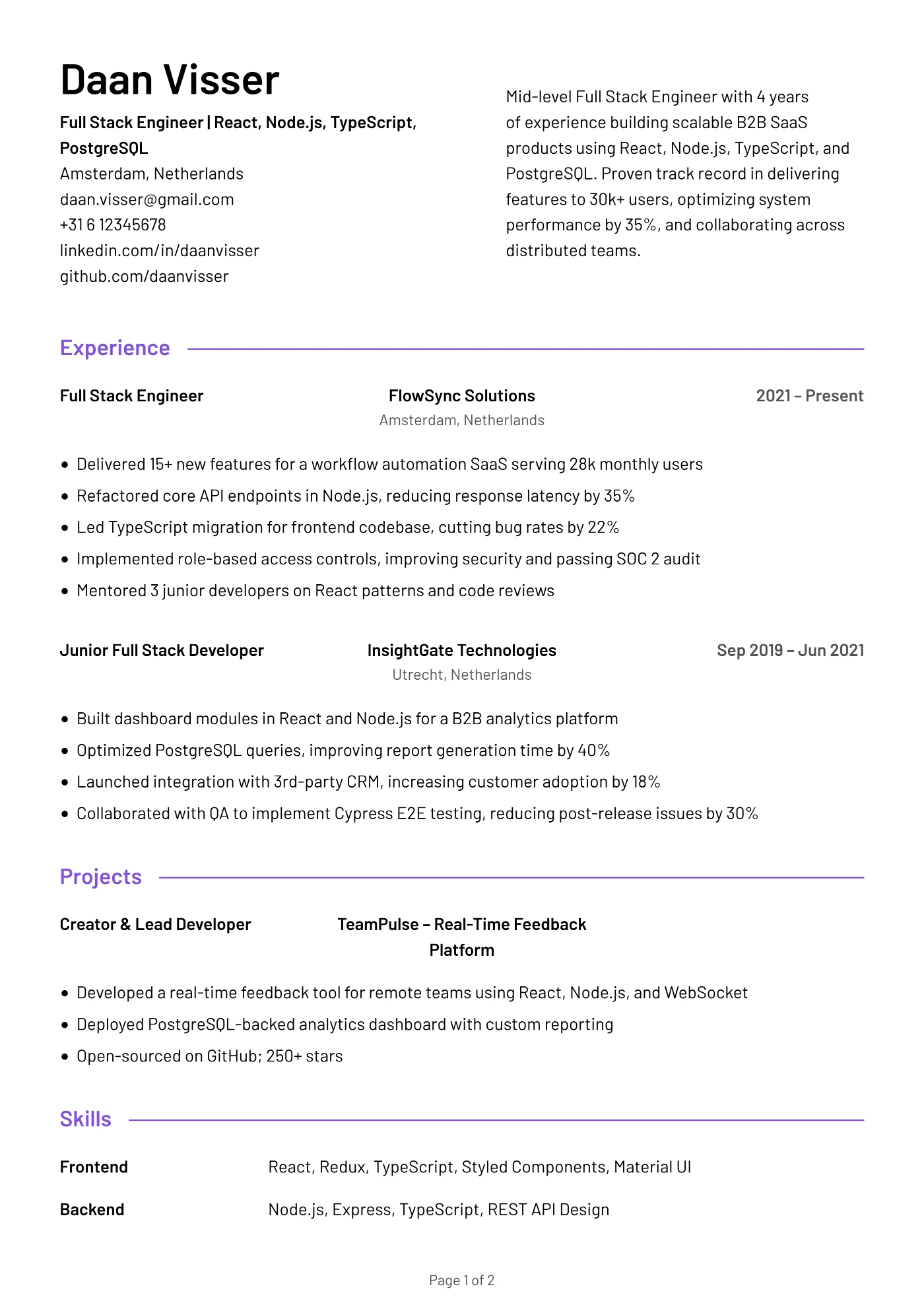
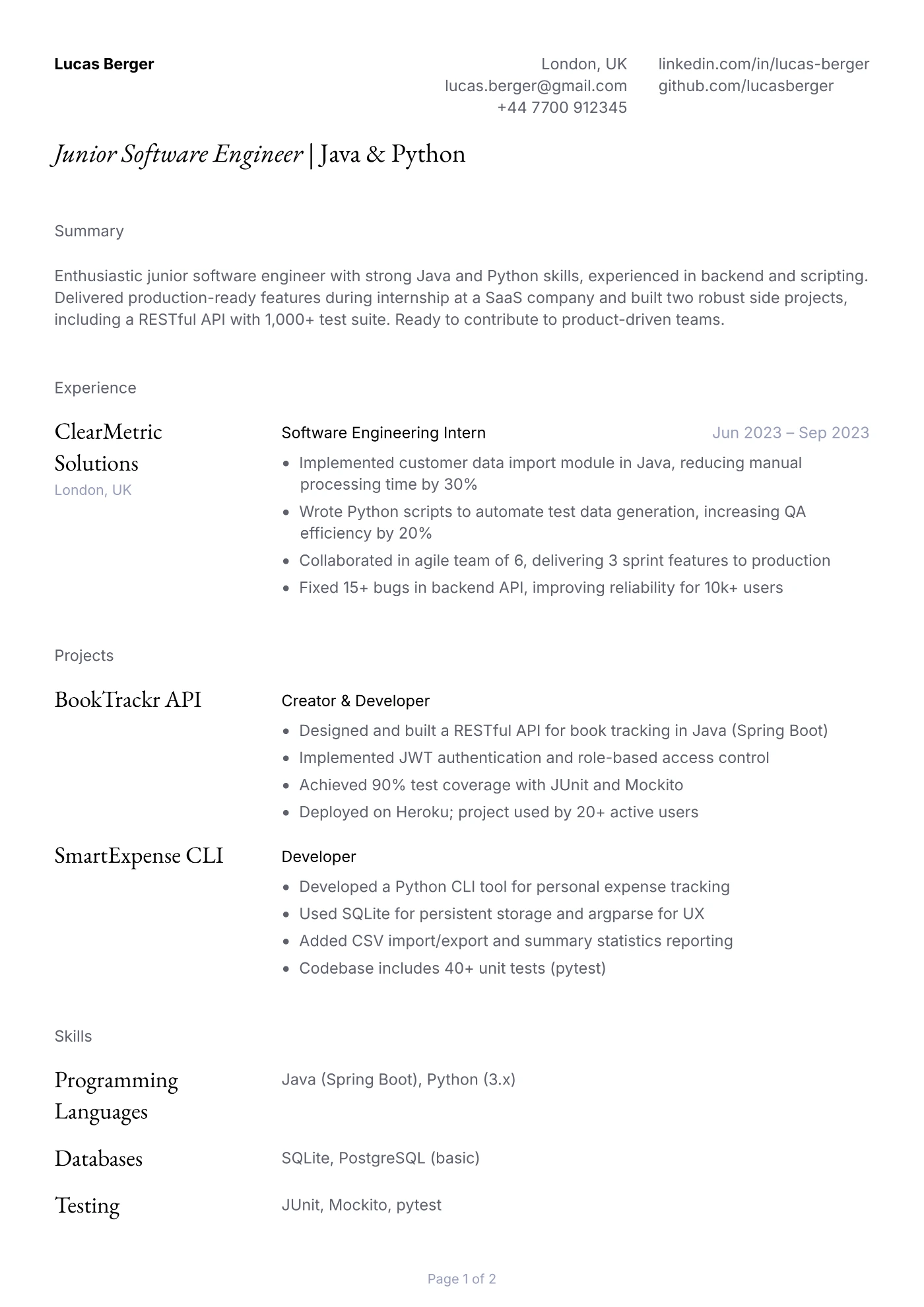
Our mid-level full stack engineer example shows an open source project listed in its own section below regular employment. The junior software engineer example describes two projects with their tests, one of them deployed and with users.
Do not create an employer to hold the gap. A founder title at a company with no product, or a consultancy with no clients, invites the questions it was meant to avoid. Courses and certificates go under education or certifications, not in the experience timeline.
Will anyone check the dates?
Sometimes, and usually after you have an offer. Some employers run a background check or contact previous employers before your start date. What a former employer confirms varies by country and by company, but dates of employment and job title are typical.
That is why the end date should come from your separation letter and not from memory or from what looks best. A resume that says "Present", or that adds three months, can fail to match the record at the stage where the offer is conditional on that check.
Keep the same month everywhere a reader may look: the resume, every application form, your LinkedIn profile, and the company field on your GitHub profile and personal site. Update them when your employment ends, not when you find the next job.
Put it into practice
Build your resume in Filiz and watch the PDF update as you edit. Start from scratch, import your current resume, or begin with an example. No sign-up needed to try it.
Frequently asked questions
What do I say if a recruiter asks whether I am still employed during my notice?
Say both facts in one sentence: "My role was eliminated in a layoff, and my last day of employment is June 30." It is accurate, it explains why the resume says "Present", and it tells the recruiter when you can start. Change the resume to the end date once that day has passed.
What if I never got a separation letter?
Ask the company in writing which date it holds as your last day of employment, and keep the reply. If nobody answers, which happens when a small startup shuts down, use the last day covered by your final payslip, which is the best record you have.
I already sent a resume that says "Present". What should I do?
Correct it at the next contact. Send the updated file or state your end date in the first call, before the recruiter asks. A resume that was accurate on the day you sent it needs no apology. One that was already out of date needs a short correction and nothing more.
Should I use years only to hide a gap?
No, not for recent jobs. "2021 – 2026" on your latest role can make a reader assume the months were left out on purpose, and application forms ask for months anyway. Years only are fine for roles that ended many years ago, where the exact month no longer matters to anyone.
How long can a gap after a layoff be before it needs an explanation?
There is no fixed threshold. A few months after a layoff rarely needs anything on the page. Once the gap is long enough that a reader would wonder what you have been building, show it with contract work, open source contributions or a shipped project, and have a one-sentence answer ready for the interview.