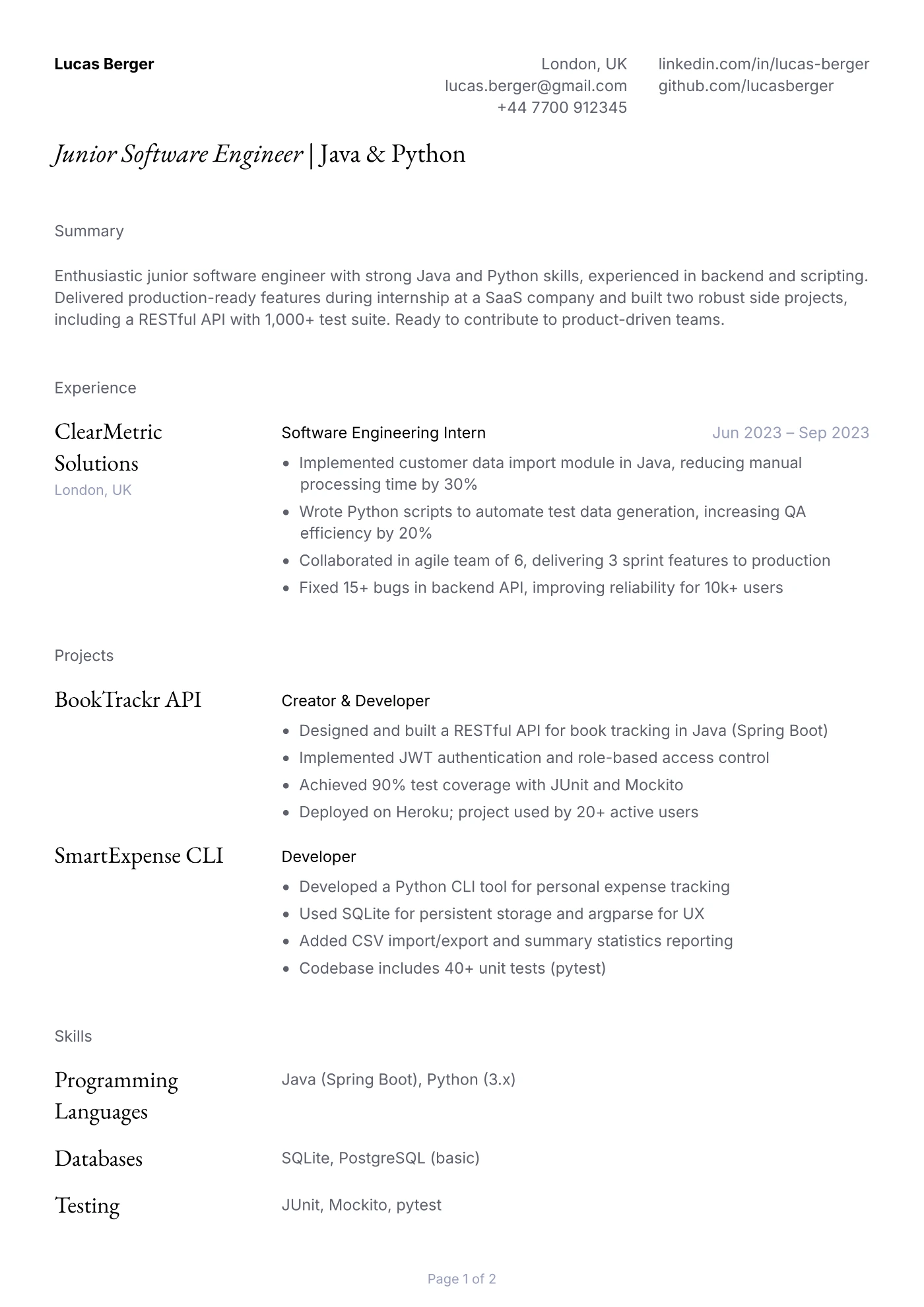
Junior Software Engineer Resume Example
A junior software engineer resume example with internship and projects. Ideal for product companies seeking Java and Python skills.
Why this works
- Internship with measurable technical impact
- Strong academic and project foundation
- Clear Java and Python proficiency
- Projects show practical, tested code
- Concise skills grouped by category
Junior Software Engineer Resume: full text
Summary
Enthusiastic junior software engineer with strong Java and Python skills, experienced in backend and scripting. Delivered production-ready features during internship at a SaaS company and built two robust side projects, including a RESTful API with 1,000+ test suite. Ready to contribute to product-driven teams.
Experience
Software Engineering Intern
ClearMetric Solutions, London, UK · Jun 2023 – Sep 2023
- Implemented customer data import module in Java, reducing manual processing time by 30%
- Wrote Python scripts to automate test data generation, increasing QA efficiency by 20%
- Collaborated in agile team of 6, delivering 3 sprint features to production
- Fixed 15+ bugs in backend API, improving reliability for 10k+ users
Projects
BookTrackr API
Creator & Developer
- Designed and built a RESTful API for book tracking in Java (Spring Boot)
- Implemented JWT authentication and role-based access control
- Achieved 90% test coverage with JUnit and Mockito
- Deployed on Heroku; project used by 20+ active users
SmartExpense CLI
Developer
- Developed a Python CLI tool for personal expense tracking
- Used SQLite for persistent storage and argparse for UX
- Added CSV import/export and summary statistics reporting
- Codebase includes 40+ unit tests (pytest)
Skills
Programming Languages
Java (Spring Boot), Python (3.x)
Databases
SQLite, PostgreSQL (basic)
Testing
JUnit, Mockito, pytest
Tools & Workflow
Git, Docker (basic), Heroku, Linux
Education
BSc Computer Science
University of Bath · 2019 – 2023
- Graduated with First Class Honours
- Final project: Automated web scraping pipeline in Python
How to write a junior software engineer resume
Hiring managers expect junior software engineer resumes to showcase strong core programming skills, hands-on project experience, and the ability to contribute to production code. Structure your resume with clear sections: summary, experience, projects, skills, and education. Highlight tangible achievements, even from internships or side projects, to demonstrate your impact.
Prioritize results from real-world experience, such as internships or substantial personal projects, especially if they involved collaboration or shipped features. Concrete metrics (like test coverage or performance gains) help validate your contributions and readiness for a junior engineering role.
What skills should a software engineer put on a resume?
A junior software engineer should focus on foundational backend programming skills, familiarity with modern development workflows, and experience with testing and databases. Demonstrating proficiency in these areas reassures employers of your ability to quickly contribute to team projects.
- Programming languages: Java (Spring Boot), Python (3.x)
- Backend frameworks: Spring Boot, REST API design
- Testing: JUnit, Mockito, pytest
- Databases: SQLite, basic PostgreSQL usage
- Dev tools & workflow: Git, Docker (basic), Linux, Heroku deployment
Software engineer resume bullet point examples
Effective bullet points for junior software engineer roles highlight your ability to deliver features, improve processes, and work collaboratively. Use action-oriented language and quantify your impact wherever possible.
- Built REST API endpoint in Spring Boot, reducing page load times by 25% for end users
- Authored Python script automating data migration, saving 10+ hours of manual work for QA team
- Collaborated with 5-person agile squad to launch new user onboarding flow within 2 sprints
- Improved backend error logging, enabling 40% faster bug resolution by support engineers
- Increased unit test coverage from 60% to 85% on legacy Java module, reducing production incidents
Common mistakes on software engineer resumes
Many junior candidates either overgeneralize or underplay their technical experience. Avoid vague claims and make sure every section is tailored to actual software engineering tasks, technologies, and results relevant to a backend-focused junior role.
- Listing programming languages without context—always pair with project or work examples
- Focusing on coursework over hands-on experience—prioritize internships and real projects
- Neglecting test coverage or QA contributions—show your role in code quality
- Overlooking deployment or workflow tools—mention Git, Docker, or CI/CD if used
Frequently asked questions
How long should a junior software engineer resume be?
A one-page resume is standard for junior software engineers. Prioritize your most relevant internships, projects, and technical skills. Avoid filler content; focus on concrete results and technologies relevant to backend software engineering.
Should I include side projects on my resume if I lack work experience?
Yes, include well-built side projects—especially those with production-quality code, testing, and deployment. These signal initiative, technical depth, and practical experience, which are highly valued for junior software engineering roles.
How can I show impact as a junior software engineer?
Demonstrate impact by quantifying your results, such as reduced processing time, increased test coverage, or user adoption metrics. Even small improvements or contributions to team workflows are valuable and show you can deliver real benefits.
Which keywords matter most for junior backend software engineer resumes?
Prioritize keywords related to your stack and workflow, such as 'Java', 'Spring Boot', 'REST API', 'JUnit', 'pytest', 'Python', 'Docker', and 'Git'. Mentioning specific tools, frameworks, and metrics increases your chances of passing applicant tracking systems and standing out to hiring managers.