Lead Backend Engineer Resume Example
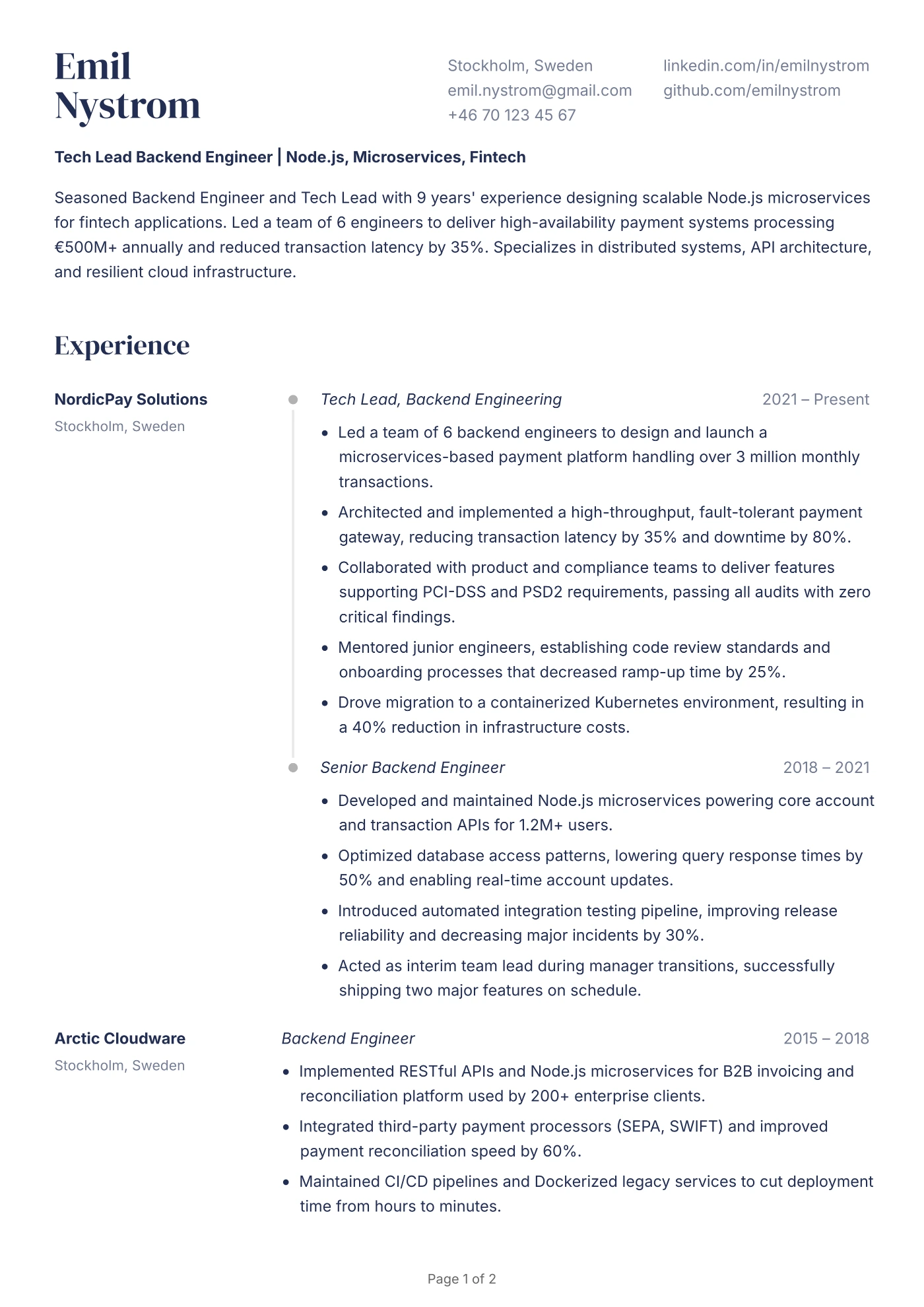
A lead backend engineer resume showcasing fintech leadership and Node.js microservices scale. Ideal for roles requiring both hands-on architecture and team management.
Why this works
- Clear promotion trajectory from engineer to lead
- Achievements quantified with transaction and latency metrics
- Strong focus on microservices and cloud infrastructure
- Mentoring and team process impact highlighted
- Fintech compliance and security expertise included
Lead Backend Engineer Resume: full text
Summary
Seasoned Backend Engineer and Tech Lead with 9 years' experience designing scalable Node.js microservices for fintech applications. Led a team of 6 engineers to deliver high-availability payment systems processing €500M+ annually and reduced transaction latency by 35%. Specializes in distributed systems, API architecture, and resilient cloud infrastructure.
Experience
Tech Lead, Backend Engineering
NordicPay Solutions, Stockholm, Sweden · 2021 – Present
- Led a team of 6 backend engineers to design and launch a microservices-based payment platform handling over 3 million monthly transactions.
- Architected and implemented a high-throughput, fault-tolerant payment gateway, reducing transaction latency by 35% and downtime by 80%.
- Collaborated with product and compliance teams to deliver features supporting PCI-DSS and PSD2 requirements, passing all audits with zero critical findings.
- Mentored junior engineers, establishing code review standards and onboarding processes that decreased ramp-up time by 25%.
- Drove migration to a containerized Kubernetes environment, resulting in a 40% reduction in infrastructure costs.
Senior Backend Engineer
NordicPay Solutions, Stockholm, Sweden · 2018 – 2021
- Developed and maintained Node.js microservices powering core account and transaction APIs for 1.2M+ users.
- Optimized database access patterns, lowering query response times by 50% and enabling real-time account updates.
- Introduced automated integration testing pipeline, improving release reliability and decreasing major incidents by 30%.
- Acted as interim team lead during manager transitions, successfully shipping two major features on schedule.
Backend Engineer
Arctic Cloudware, Stockholm, Sweden · 2015 – 2018
- Implemented RESTful APIs and Node.js microservices for B2B invoicing and reconciliation platform used by 200+ enterprise clients.
- Integrated third-party payment processors (SEPA, SWIFT) and improved payment reconciliation speed by 60%.
- Maintained CI/CD pipelines and Dockerized legacy services to cut deployment time from hours to minutes.
- Worked closely with frontend and QA teams to ensure end-to-end delivery of secure, reliable features.
Junior Backend Developer
Fjord Systems, Uppsala, Sweden · Jan 2014 – Dec 2014
- Built and maintained Node.js APIs for internal accounting tools, processing 50k+ records daily.
- Wrote robust unit tests, increasing backend code coverage from 45% to 80%.
- Participated in agile ceremonies and contributed to planning and estimation.
Skills
Backend & APIs
Node.js, TypeScript, Express.js, REST/GraphQL APIs, API Gateway
Cloud & DevOps
Docker, Kubernetes, AWS (ECS, Lambda, RDS, S3), Terraform, CI/CD (GitHub Actions, Jenkins)
Data & Storage
PostgreSQL, Redis, MongoDB, Kafka, RabbitMQ
Testing & Quality
Jest, Mocha, Supertest, Integration/Contract Testing
Architecture & Security
Microservices, Domain-Driven Design, OAuth2/JWT, PCI-DSS Compliance
Education
MSc Computer Science
KTH Royal Institute of Technology · Sep 2011 – Jun 2013
Thesis: Scalable Node.js Microservices for Financial Applications
BSc Software Engineering
Uppsala University · 2008 – 2011
How to write a lead backend engineer resume
A lead backend engineer resume should highlight both technical leadership and deep hands-on expertise in backend architecture and cloud infrastructure. Hiring managers expect to see clear evidence of influencing technical direction, delivering robust systems at scale, and driving process improvements within high-transaction domains like fintech. Prioritize outcomes—show how your work improved performance, reliability, or compliance.
Structure your resume with a concise summary, detailed experience sections focusing on your leadership and technical achievements, and a tailored skills list. Emphasize metrics that illustrate impact (e.g., transaction volume, latency reduction, cost savings), and showcase your experience with distributed systems, regulatory compliance, and cloud-native technologies.
What skills should a backend engineer put on a resume?
Backend engineers at the lead level should present a balance of architectural vision, deep stack knowledge, and experience collaborating across teams. Your resume should group skills to reflect technical breadth, leadership, and domain-specific expertise.
- Programming & APIs: Node.js, TypeScript, Express.js, REST, GraphQL
- Cloud & DevOps: AWS (ECS, Lambda, RDS, S3), Docker, Kubernetes, Terraform, CI/CD pipelines (GitHub Actions, Jenkins)
- Databases & Messaging: PostgreSQL, Redis, MongoDB, Kafka, RabbitMQ
- Testing & Quality: Jest, Mocha, Supertest, integration/contract testing
- Architecture & Security: Microservices, Domain-Driven Design, OAuth2/JWT, PCI-DSS compliance
- Team Leadership: Technical mentorship, code review standards, cross-functional collaboration
Backend engineer resume bullet point examples
Strong achievement bullets for lead backend engineers should show leadership, technical depth, and measurable outcomes. Use action verbs, specify the scale and technology, and quantify impact where possible.
- Spearheaded migration of legacy payment APIs to microservices, enabling 99.98% uptime and supporting 4M+ monthly users.
- Devised and implemented database sharding strategy in PostgreSQL, improving horizontal scalability and halving peak-hour response times.
- Directed cross-team initiative to automate compliance checks, achieving PCI-DSS recertification with 100% audit pass rate.
- Mentored 8 engineers, leading to two internal promotions and improved team delivery velocity by 22%.
- Optimized Kafka-based notification system to handle a 3x spike in transaction events without service degradation.
Common mistakes on backend engineer resumes
For lead backend engineer roles, common resume pitfalls include underrepresenting leadership, vague technical scope, and not quantifying achievements. Address these issues to make your resume stand out in fintech and high-scale environments.
- Focusing only on code, not leadership—add mentoring, hiring, and process improvements.
- Listing technologies without context—explain how you used each tool to solve specific challenges.
- Omitting measurable outcomes—always include metrics (e.g., % latency reduction, transaction volume).
- Neglecting regulatory or security work—highlight experience with PCI-DSS, PSD2, or similar compliance.
Frequently asked questions
How long should a lead backend engineer resume be?
A two-page resume is appropriate for a lead backend engineer. This length allows you to detail both technical depth and leadership achievements across multiple roles, especially if you’ve overseen complex projects, teams, or compliance initiatives. Use clear sections and only include relevant, recent experience.
Should I list side projects or open-source contributions as a lead backend engineer?
Include side projects or open-source work if they showcase leadership, design skills, or technologies relevant to the fintech/backend space. Emphasize your role, impact, and any adoption metrics. Projects demonstrating team collaboration, security, or large-scale architecture are especially valuable at this level.
How do I highlight leadership on a backend engineer resume?
Highlight leadership by detailing how you guided teams, set technical direction, mentored peers, or improved processes. Quantify your influence—mention team sizes, mentorship outcomes, or accelerated delivery timelines. Examples include introducing new standards, leading migrations, or driving compliance initiatives.
Which keywords should a lead backend engineer use to get past ATS filters?
Use specific keywords like Node.js, TypeScript, microservices, Kubernetes, AWS, PCI-DSS, REST APIs, CI/CD, PostgreSQL, Kafka, and mentoring or technical leadership. Align them with the job description and contextually place them in your achievements, not just in the skills section, to maximize ATS relevance.