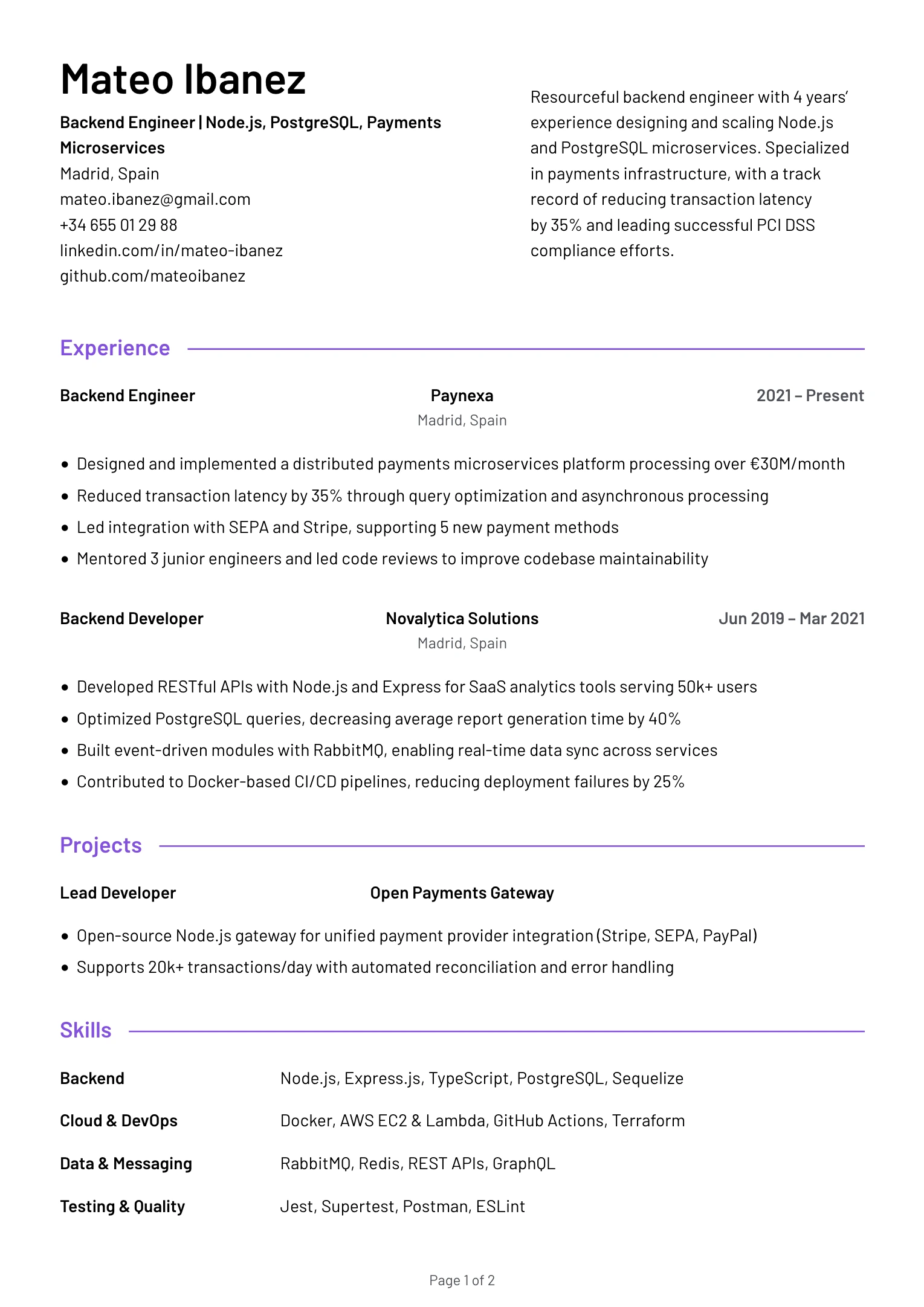
Mid-Level Backend Engineer Resume Example
A backend engineer resume example with Node.js and PostgreSQL. Ideal for payments and microservices SaaS roles.
Why this works
- Strong metrics on payments system impact
- Clear microservices and cloud focus
- Open-source project with real usage
- Mentorship and compliance achievements
- Well-organized grouped technical skills
Mid-Level Backend Engineer Resume: full text
Summary
Resourceful backend engineer with 4 years’ experience designing and scaling Node.js and PostgreSQL microservices. Specialized in payments infrastructure, with a track record of reducing transaction latency by 35% and leading successful PCI DSS compliance efforts.
Experience
Backend Engineer
Paynexa, Madrid, Spain · 2021 – Present
- Designed and implemented a distributed payments microservices platform processing over €30M/month
- Reduced transaction latency by 35% through query optimization and asynchronous processing
- Led integration with SEPA and Stripe, supporting 5 new payment methods
- Mentored 3 junior engineers and led code reviews to improve codebase maintainability
Backend Developer
Novalytica Solutions, Madrid, Spain · Jun 2019 – Mar 2021
- Developed RESTful APIs with Node.js and Express for SaaS analytics tools serving 50k+ users
- Optimized PostgreSQL queries, decreasing average report generation time by 40%
- Built event-driven modules with RabbitMQ, enabling real-time data sync across services
- Contributed to Docker-based CI/CD pipelines, reducing deployment failures by 25%
Projects
Open Payments Gateway
Lead Developer
- Open-source Node.js gateway for unified payment provider integration (Stripe, SEPA, PayPal)
- Supports 20k+ transactions/day with automated reconciliation and error handling
Skills
Backend
Node.js, Express.js, TypeScript, PostgreSQL, Sequelize
Cloud & DevOps
Docker, AWS EC2 & Lambda, GitHub Actions, Terraform
Data & Messaging
RabbitMQ, Redis, REST APIs, GraphQL
Testing & Quality
Jest, Supertest, Postman, ESLint
Education
BSc Computer Engineering
Universidad Politécnica de Madrid · 2015 – 2019
How to write a mid-level backend engineer resume
Hiring managers for mid-level backend engineer roles expect to see hands-on experience with backend systems, especially around designing, building, and optimizing microservices. Your resume should highlight measurable impacts—such as latency reduction, uptime improvements, or successful integrations—that show technical depth and accountability for outcomes.
Structure your page with a clear summary, focused experience bullets detailing your impact, a dedicated skills section listing your core technologies (Node.js, PostgreSQL, Docker, etc.), and relevant projects. Prioritize recent, production-level work on payments or high-volume transactional systems, and mention any mentorship or leadership within projects.
What skills should a backend engineer put on a resume?
Demonstrate technical breadth and depth by grouping technologies into relevant categories. For this backend engineer role, recruiters will look for stack familiarity and evidence of production use.
- Backend development: Node.js, Express.js, TypeScript, PostgreSQL, Sequelize
- Cloud & DevOps: Docker, AWS (EC2, Lambda), GitHub Actions, Terraform
- Data & Messaging: RabbitMQ, Redis, REST APIs, GraphQL
- Testing & Quality: Jest, Supertest, Postman, ESLint
- Payments & Integrations: SEPA, Stripe, PayPal, PCI DSS compliance
Backend engineer resume bullet point examples
Use action-driven bullet points that reflect your technical contributions and measurable results. Focus on achievements involving payment systems, microservices, and cloud or DevOps tooling.
- Automated payment reconciliation workflows, reducing manual intervention hours by 60% monthly
- Migrated legacy payment processing to containerized microservices, improving system scalability for 25k+ concurrent users
- Implemented GraphQL endpoints, enabling a 2x faster onboarding for new external partners
- Developed a Redis caching strategy, reducing API response times by 40% during peak loads
- Established API versioning standards, decreasing integration issues with third-party payment providers by 30%
Common mistakes on backend engineer resumes
Backend resumes often fail to stand out due to vague responsibilities or omitting critical stack details. Ensure your achievements are quantified and your technical scope is clear.
- Listing technologies without context—always show how you applied them to business outcomes
- Overlooking measurable results—quantify latency, throughput, or error reductions
- Neglecting DevOps and testing contributions—highlight your role in CI/CD or quality
- Failing to mention payment or compliance experience if relevant—call out PCI DSS, SEPA, etc.
Frequently asked questions
How long should my mid-level backend engineer resume be?
Aim for a one-page resume focused on your last 3–5 years. Prioritize experience with the core stack (Node.js, PostgreSQL, Docker, AWS) and highlight measurable achievements on payments or high-throughput systems.
Should I include open-source or side projects for mid backend roles?
Yes, especially if they demonstrate relevant technical skills or scale (e.g., payment gateways, microservices). Clearly state your role and the technologies used—these projects can set you apart if they align with the position's requirements.
How do I show scale or impact for backend projects?
Use specifics: mention transaction volumes, system uptimes, latency improvements, or integration counts. Metrics like “supported €30M/month in payments” or “reduced API response times by 40%” quickly convey scale and technical impact.
Which keywords are critical for backend engineer resumes in payments?
Include keywords like Node.js, PostgreSQL, Docker, AWS, RabbitMQ, payment integrations (SEPA, Stripe, PayPal), PCI DSS, and microservices. Also mention CI/CD, REST APIs, and caching. Match your exact stack to the job for better ATS and recruiter visibility.