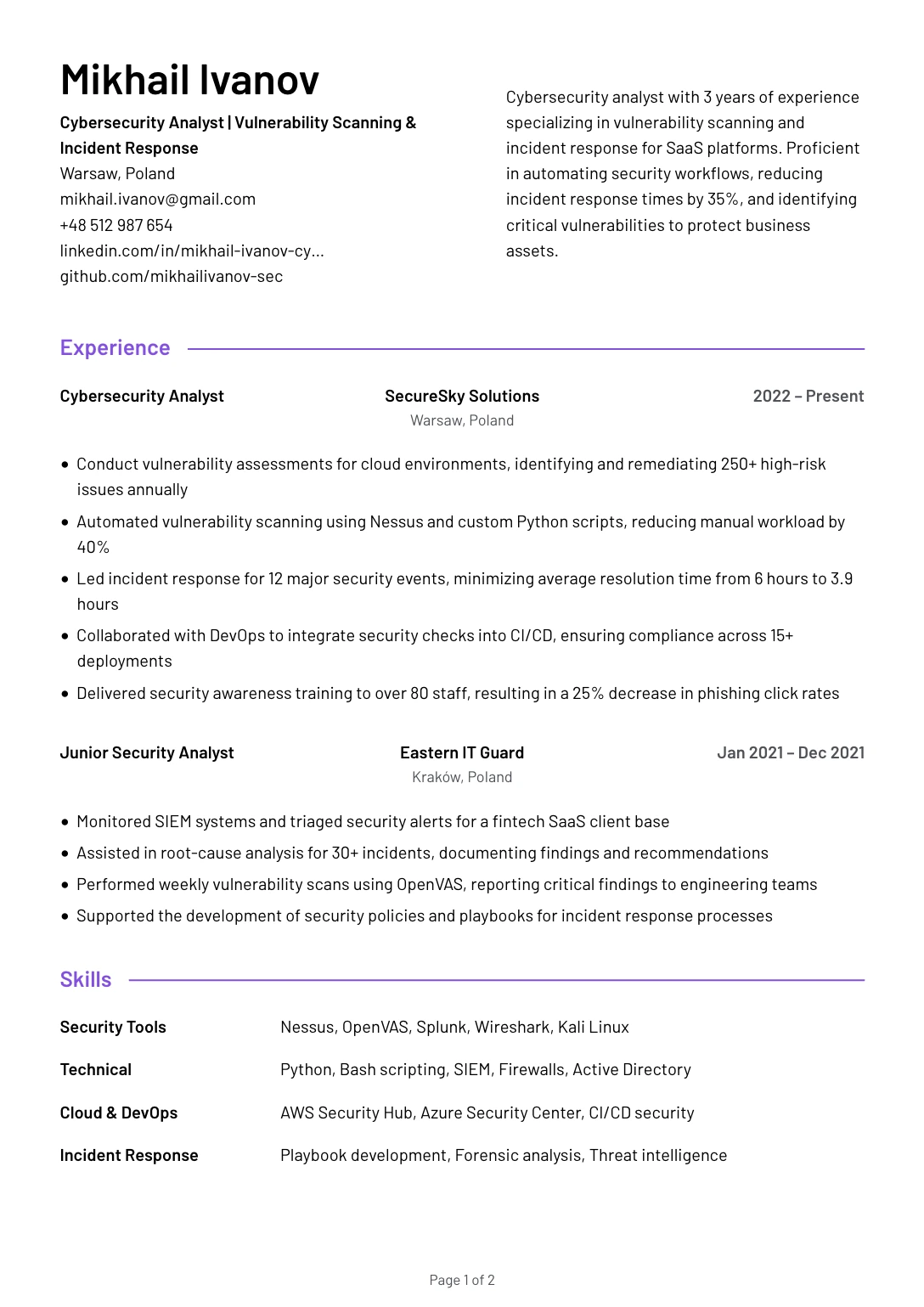
Mid-Level Cybersecurity Analyst Resume Example
A cybersecurity analyst resume example with proven impact in vulnerability scanning and incident response. Ideal for mid-level roles in SaaS and tech companies.
Why this works
- Quantified results in every bullet
- Clear focus on core security skills
- Relevant tools and technologies grouped
- Education aligns with the role
- Concise summary with measurable impact
Mid-Level Cybersecurity Analyst Resume: full text
Summary
Cybersecurity analyst working on vulnerability management and incident response for SaaS and fintech clients for the past 3 years. Runs cloud vulnerability assessments, automates scanning with Nessus and Python, and has led the response on 12 major incidents.
Experience
Cybersecurity Analyst
SecureSky Solutions, Warsaw, Poland · 2022 – Present
- Run vulnerability assessments across client cloud environments and track 250+ high-risk findings a year through to remediation
- Scheduled Nessus scans and wrote Python scripts to dedupe and route the results, replacing a day a week of manual triage
- Led incident response on 12 major security events; average time to resolve fell to 3.9 hours, from 6
- Added security checks to the CI/CD pipelines for 15 services, working out with the DevOps team which findings should fail a build
- Ran security awareness training for 80 staff, after which the click rate on the quarterly phishing test fell from 12% to 9%
Junior Security Analyst
Eastern IT Guard, Kraków, Poland · Jan 2021 – Dec 2021
- Monitored SIEM systems and triaged security alerts for a fintech SaaS client base
- Assisted in root-cause analysis for 30+ incidents, documenting findings and recommendations
- Performed weekly vulnerability scans using OpenVAS, reporting critical findings to engineering teams
- Helped write the incident response playbooks and the security policies they reference
Skills
Security Tools
Nessus, OpenVAS, Splunk, Wireshark, Kali Linux
Technical
Python, Bash scripting, SIEM, Firewalls, Active Directory
Cloud & DevOps
AWS Security Hub, Azure Security Center, CI/CD security
Incident Response
Playbook development, Forensic analysis, Threat intelligence
Education
BSc Information Security
Warsaw University of Technology · 2017 – 2020
Relevant coursework: Network Security, Cryptography, Penetration Testing
How to write a mid-level cybersecurity analyst resume
Hiring managers for mid-level cybersecurity analyst roles expect to see hands-on technical experience, especially with vulnerability management, incident response, and automation in SaaS or cloud environments. Structure your resume to highlight measurable impact, such as reduced incident response times or the number of vulnerabilities remediated, and show progressive responsibility from earlier roles.
Prioritize sections that demonstrate technical expertise, relevant security tools, and direct contributions to organizational security. Place your most recent and impactful experience first, follow with technical skills (tools, scripting languages, cloud security platforms), and include any formal education or certifications relevant to cybersecurity.
What skills should a cybersecurity analyst put on a resume?
A strong cybersecurity analyst resume should showcase proficiency in security tools, scripting, cloud security solutions, and incident response. Group related skills to make them easy to scan and ensure you list the technologies and processes used within SaaS or cloud-first environments.
- Vulnerability management: Nessus, OpenVAS, vulnerability assessment, remediation workflows
- Security monitoring: Splunk, SIEM platforms, alert triage, log analysis
- Automation & scripting: Python, Bash, custom security automation workflows
- Cloud security: AWS Security Hub, Azure Security Center, securing CI/CD pipelines
- Incident response: Playbook development, forensic analysis, threat intelligence, root-cause analysis
- Network & endpoint security: Wireshark, Firewalls, Active Directory, penetration testing tools
Cybersecurity analyst resume bullet point examples
Quantifiable achievements make your resume stand out by showing real-world impact. Use bullet points that describe your actions, the context, and the outcome, supported by relevant metrics or improvements.
- Automated threat intelligence enrichment in SIEM, reducing false positives by 20% and improving analyst triage speed.
- Developed Python scripts to correlate cloud access logs, identifying two previously undetected data exfiltration attempts.
- Coordinated tabletop exercises for incident response teams, improving response protocol adherence from 68% to 90%.
- Integrated AWS Security Hub findings into monthly risk reports, streamlining audit preparation for two compliance reviews.
- Enhanced phishing detection rules in Splunk, decreasing undetected phishing attempts by 30% over six months.
Common mistakes on cybersecurity analyst resumes
Cybersecurity analyst resumes often overlook the need for clear, measurable achievements or fail to demonstrate practical use of modern security tools. Avoid these common mistakes to highlight your fit for a mid-level role.
- Listing tools without context—always describe how you used them and the impact.
- Focusing solely on daily tasks instead of quantifiable outcomes or improvements.
- Neglecting cloud and SaaS security experience when applying to modern environments.
- Omitting automation or scripting skills that illustrate process improvements.
Frequently asked questions
How long should a mid cybersecurity analyst resume be?
A one-page resume is ideal for mid-level cybersecurity analysts with up to five years of experience. Focus on your most relevant achievements, technical skills, and measurable impact to keep your resume concise and effective.
Should I include side projects or certifications on my cybersecurity analyst resume?
Include side projects only if they demonstrate hands-on experience with relevant security tools, automation, or cloud environments. Certifications like CompTIA Security+, CEH, or AWS Security Specialty strengthen your application and should be listed if relevant.
How can I show leadership on a cybersecurity analyst resume at this level?
Highlight any experience leading incident response efforts, conducting security training, developing playbooks, or improving team processes. Even as a mid-level analyst, showing ownership of projects or mentoring junior staff signals leadership potential.
Which keywords matter most for a mid cybersecurity analyst applying to SaaS or cloud-focused companies?
Prioritize keywords like vulnerability management, incident response, SIEM, cloud security (AWS, Azure), automation, threat intelligence, and DevOps security. Include specific tool names (Nessus, Splunk, Python) and process-related phrases to align with job descriptions and pass ATS scans.