Mid-Level DevOps Engineer Resume Example
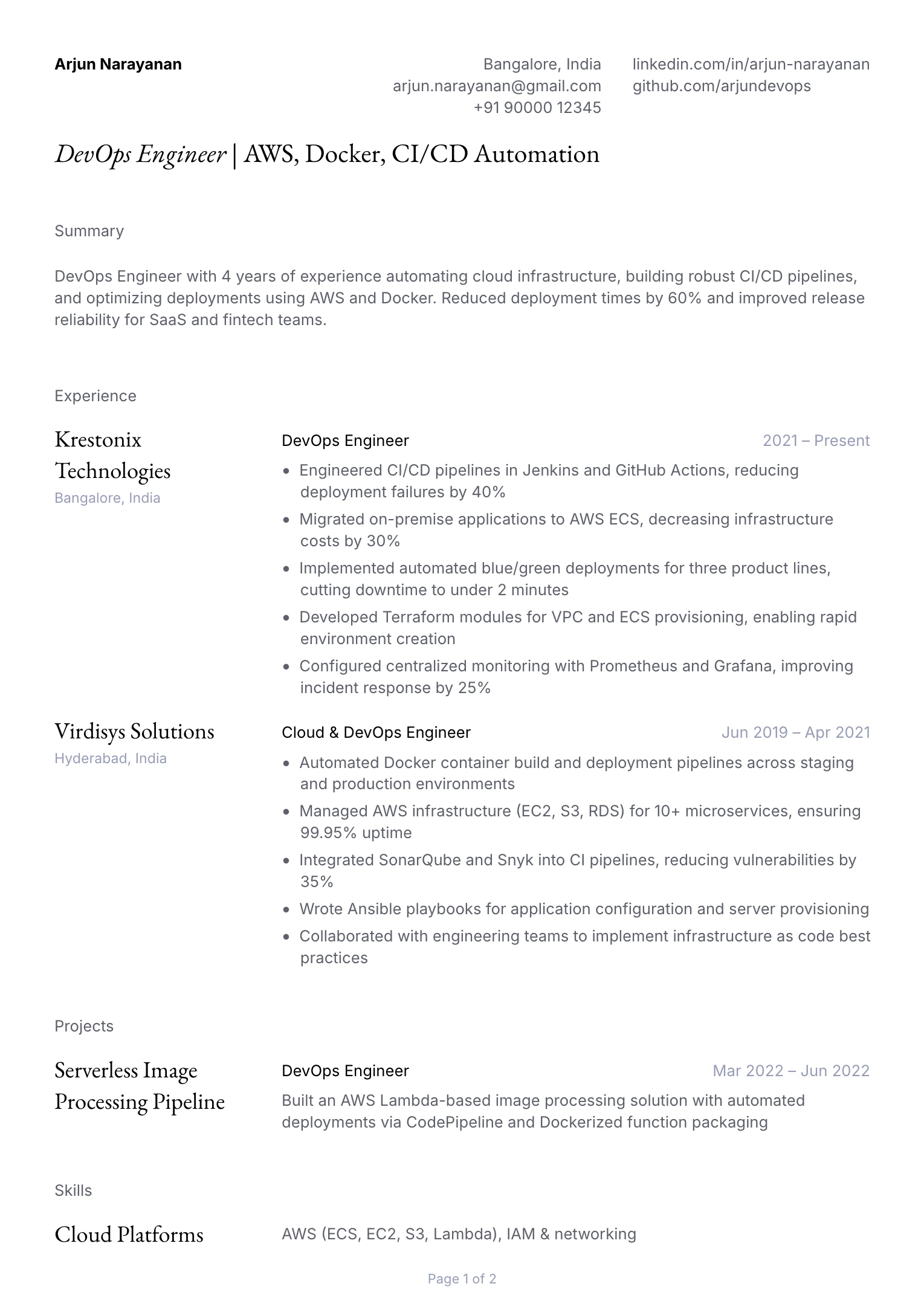
A mid-level DevOps engineer resume showing AWS, Docker, and CI/CD automation impact. Ideal for SaaS and cloud infrastructure roles.
Why this works
- Impact-first bullets with clear metrics
- Strong focus on AWS and Docker expertise
- Relevant project with real-world stack
- Education aligned with DevOps skills
- Well-organized, ATS-friendly structure
Mid-Level DevOps Engineer Resume: full text
Summary
DevOps Engineer with 4 years of experience automating cloud infrastructure, building CI/CD pipelines, and running deployments on AWS and Docker. Cut build times from 24 to 9 minutes and moved 11 applications to AWS ECS for SaaS and fintech teams.
Experience
DevOps Engineer
Krestonix Technologies, Bangalore, India · 2021 – Present
- Rebuilt the CI/CD pipelines in GitHub Actions, replacing Jenkins, and cut a typical build from 24 to 9 minutes
- Migrated 11 on-premise applications to AWS ECS, reducing monthly infrastructure spend from $38k to $27k
- Implemented automated blue/green deployments for three product lines, cutting downtime to under 2 minutes
- Developed the Terraform modules for VPC and ECS provisioning that all 6 product teams use to create environments
- Set up centralized monitoring with Prometheus and Grafana and wrote the on-call runbooks for the platform team
Cloud & DevOps Engineer
Virdisys Solutions, Hyderabad, India · Jun 2019 – Apr 2021
- Automated Docker container build and deployment pipelines across staging and production environments
- Managed AWS infrastructure (EC2, S3, RDS) for 10+ microservices, ensuring 99.95% uptime
- Integrated SonarQube and Snyk into CI pipelines and cleared a backlog of 60+ high-severity findings in two quarters
- Wrote Ansible playbooks for application configuration and server provisioning
- Collaborated with engineering teams to implement infrastructure as code best practices
Projects
Serverless Image Processing Pipeline
DevOps Engineer · Mar 2022 – Jun 2022
Built an AWS Lambda-based image processing solution with automated deployments via CodePipeline and Dockerized function packaging
Skills
Cloud Platforms
AWS (ECS, EC2, S3, Lambda), IAM & networking
Containers & Orchestration
Docker, ECS, Kubernetes (basic)
CI/CD & Automation
Jenkins, GitHub Actions, Terraform, Ansible
Monitoring & Logging
Prometheus, Grafana, AWS CloudWatch
Languages & Scripting
Python, Bash
Education
BTech Computer Science and Engineering
National Institute of Technology Karnataka · 2015 – 2019
Relevant coursework: Cloud Computing, Distributed Systems
How to write a mid-level DevOps engineer resume
Hiring managers for mid-level DevOps engineer roles want to see clear evidence of technical ownership, automation impact, and hands-on experience with infrastructure-as-code and cloud platforms. Structure your resume to showcase quantifiable achievements—especially those involving AWS, Docker, CI/CD, and automation tools.
Organize your experience by highlighting the technologies you used and the specific improvements you delivered in deployment, reliability, and cost or performance optimization. Include a technical skills section listing your core stack, and describe major projects or migrations to show depth with tools like Terraform, Jenkins, or container orchestration.
What skills should a DevOps engineer put on a resume?
DevOps engineers should highlight a blend of cloud, automation, scripting, and monitoring skills. Focus on tools, platforms, and practices relevant to modern SaaS or fintech environments.
- Cloud Infrastructure: AWS (ECS, EC2, S3, Lambda), IAM, VPC, networking
- Containers & Orchestration: Docker, ECS, Kubernetes (basic proficiency)
- CI/CD & Automation: Jenkins, GitHub Actions, Terraform, Ansible, CodePipeline
- Monitoring & Logging: Prometheus, Grafana, AWS CloudWatch, SonarQube
- Scripting & Programming: Python, Bash
- Security & Compliance: Vulnerability scanning (Snyk), access controls
DevOps engineer resume bullet point examples
Well-written bullet points should illustrate automation, reliability, and efficiency improvements. Use metrics and mention the specific tools or processes you owned.
- Automated zero-downtime deployments with blue/green strategies in AWS ECS, reducing failed deployments by 50% across 5+ microservices.
- Developed custom Terraform modules to standardize VPC and subnet provisioning, cutting environment setup time from days to under 2 hours.
- Integrated AWS CloudWatch alerts with Slack for real-time incident notification, improving mean time to recovery (MTTR) by 30%.
- Optimized Docker image builds to reduce container startup latency by 40%, accelerating development feedback cycles.
- Led migration of CI workflows from Jenkins to GitHub Actions, boosting pipeline reliability and reducing maintenance overhead.
Common mistakes on DevOps engineer resumes
DevOps resumes often fall short by omitting quantifiable outcomes or by being too vague about tooling. Avoid these pitfalls to stand out.
- Listing tools without context—always describe how you used them to solve problems or improve processes.
- Neglecting to quantify impact—show measurable results (e.g., reduced downtime, faster deployments).
- Overlooking security practices—mention vulnerability scanning and access management if relevant to your work.
- Failing to demonstrate collaboration—show how you worked with developers or other teams to drive DevOps adoption.
Frequently asked questions
How long should a mid-level DevOps engineer resume be?
One page is ideal unless you have 6+ years of experience or extensive relevant projects. Focus on recent roles, automation achievements, and technical impact. Prioritize depth over breadth for each position—detail your main contributions and the tools used.
Should I include side projects or certifications on my DevOps resume?
Include side projects if they showcase relevant tools (like AWS Lambda, Docker, or CI/CD) or significant results. Certifications (e.g., AWS Solutions Architect Associate) are valuable, especially if the job description mentions them, but prioritize project impact and hands-on skills first.
How can I show leadership or ownership as a mid-level DevOps engineer?
Highlight initiatives you drove independently, such as migrating to new CI/CD tools, leading automation efforts, or standardizing infrastructure with Terraform. Mention collaborating with multiple teams, mentoring juniors, or creating internal documentation and best practices.
Which keywords matter most for a DevOps engineer resume?
Keywords like AWS, Docker, Terraform, Jenkins, CI/CD, Infrastructure as Code, monitoring (Prometheus/Grafana), automation, and security (Snyk, IAM) are important. Tailor your resume to match the job description’s phrasing and tools, but don’t overstuff—contextualize each keyword in your achievements.