Mid-Level Android Developer Resume Example
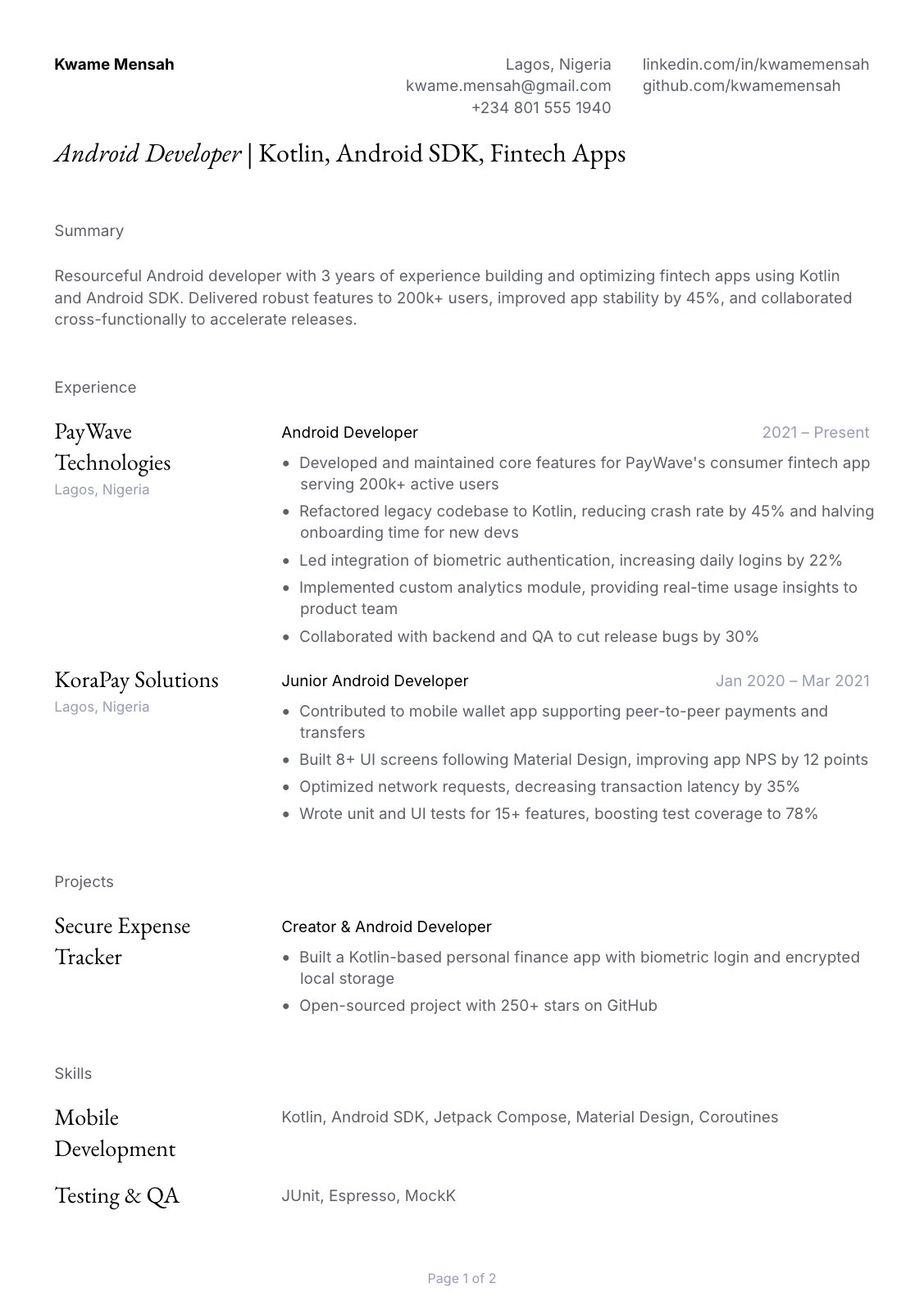
A mid-level Android developer resume example displaying Kotlin expertise and fintech project impact. Perfect for mobile roles in financial tech and consumer apps.
Why this works
- Metrics highlight user and stability gains
- Realistic fintech domain experience
- Clear Kotlin and Android SDK skills
- Project section with open-source proof
- Testing and release skills grouped logically
Mid-Level Android Developer Resume: full text
Summary
Resourceful Android developer with 3 years of experience building and optimizing fintech apps using Kotlin and Android SDK. Delivered robust features to 200k+ users, improved app stability by 45%, and collaborated cross-functionally to accelerate releases.
Experience
Android Developer
PayWave Technologies, Lagos, Nigeria · 2021 – Present
- Developed and maintained core features for PayWave's consumer fintech app serving 200k+ active users
- Refactored legacy codebase to Kotlin, reducing crash rate by 45% and halving onboarding time for new devs
- Led integration of biometric authentication, increasing daily logins by 22%
- Implemented custom analytics module, providing real-time usage insights to product team
- Collaborated with backend and QA to cut release bugs by 30%
Junior Android Developer
KoraPay Solutions, Lagos, Nigeria · Jan 2020 – Mar 2021
- Contributed to mobile wallet app supporting peer-to-peer payments and transfers
- Built 8+ UI screens following Material Design, improving app NPS by 12 points
- Optimized network requests, decreasing transaction latency by 35%
- Wrote unit and UI tests for 15+ features, boosting test coverage to 78%
Projects
Secure Expense Tracker
Creator & Android Developer
- Built a Kotlin-based personal finance app with biometric login and encrypted local storage
- Open-sourced project with 250+ stars on GitHub
Skills
Mobile Development
Kotlin, Android SDK, Jetpack Compose, Material Design, Coroutines
Testing & QA
JUnit, Espresso, MockK
Tooling & DevOps
Git, Gradle, Firebase, Crashlytics, Bitrise
APIs & Data
REST APIs, Retrofit, Room, Gson
Education
BSc Computer Science
Obafemi Awolowo University · 2015 – 2019
How to write a mid-level Android developer resume
A strong mid-level Android developer resume should demonstrate hands-on experience delivering robust Android apps, especially with the Kotlin language and Android SDK. Hiring managers at this level look for candidates who can independently implement features, improve performance, and collaborate with product and QA teams. Prioritize impact, scalability, and evidence of ownership in your experience section.
Organize your resume with a clear summary, detailed work experience focused on relevant fintech or consumer apps, and highlight your technical stack. Feature quantifiable achievements such as user growth, stability improvements, or reductions in bug rates. Include a dedicated skills section that accurately reflects your proficiency with modern Android development tools and libraries.
What skills should an Android developer put on a resume?
Focus on skills relevant to Android app development, emphasizing both core programming and tooling knowledge. Show proficiency in modern Android frameworks and patterns, testing, and collaboration tools.
- Programming Languages & Frameworks: Kotlin, Android SDK, Jetpack Compose, Coroutines, Material Design
- Testing & Quality Assurance: JUnit, Espresso, MockK
- Tooling & CI/CD: Git, Gradle, Bitrise, Firebase, Crashlytics
- API & Data Handling: REST APIs, Retrofit, Room, Gson
- Collaboration: Agile methodologies, cross-functional teamwork
Android developer resume bullet point examples
Use achievement-oriented bullet points to show the real impact of your work. Quantify improvements, stability, or user engagement wherever possible.
- Engineered a push notification system using Firebase Cloud Messaging, increasing user engagement by 18%.
- Migrated legacy network layer to Retrofit and Coroutines, reducing API response time by 40%.
- Designed and implemented a dark mode feature, resulting in a 16% increase in user retention over 3 months.
- Automated build and deployment workflows with Bitrise, decreasing release cycle time by 25%.
- Created comprehensive test suites with Espresso and MockK, driving overall app test coverage from 65% to 85%.
Common mistakes on Android developer resumes
Avoid these pitfalls to ensure your resume showcases your strengths as an Android developer. Focus on relevant, modern skills and real contributions.
- Listing outdated technologies (e.g., Java-only experience) instead of modern Kotlin and Compose skills.
- Neglecting to quantify results—always include metrics like crash rate reduction or user growth.
- Overlooking testing and QA contributions—highlight your role in improving app stability and coverage.
- Vague descriptions of teamwork—be specific about your collaboration with design, backend, or QA teams.
Frequently asked questions
How long should a mid-level Android developer resume be?
A mid-level Android developer resume should be one page if possible, but up to two pages is acceptable if you have several relevant projects and quantifiable achievements. Prioritize recent, impactful work and trim unrelated experience to maintain clarity.
Should I include side projects or open-source contributions?
Yes, relevant side projects or open-source contributions should be included, especially if they showcase skills like Kotlin, security, or modern Android libraries. They demonstrate initiative and passion, and can help differentiate you from other candidates.
How do I show leadership or ownership as a mid-level Android developer?
Show ownership by highlighting features or modules you independently delivered, processes you improved, or mentoring you provided to junior developers. Quantify impact wherever possible, such as improved stability, faster onboarding, or increased app usage.
Which keywords matter most for Android developer resumes?
Prioritize keywords like Kotlin, Android SDK, Jetpack Compose, Coroutines, REST APIs, Retrofit, Material Design, and mobile testing frameworks (JUnit, Espresso). Including tools like Git, Gradle, Firebase, and Crashlytics can also help your resume get noticed by applicant tracking systems.