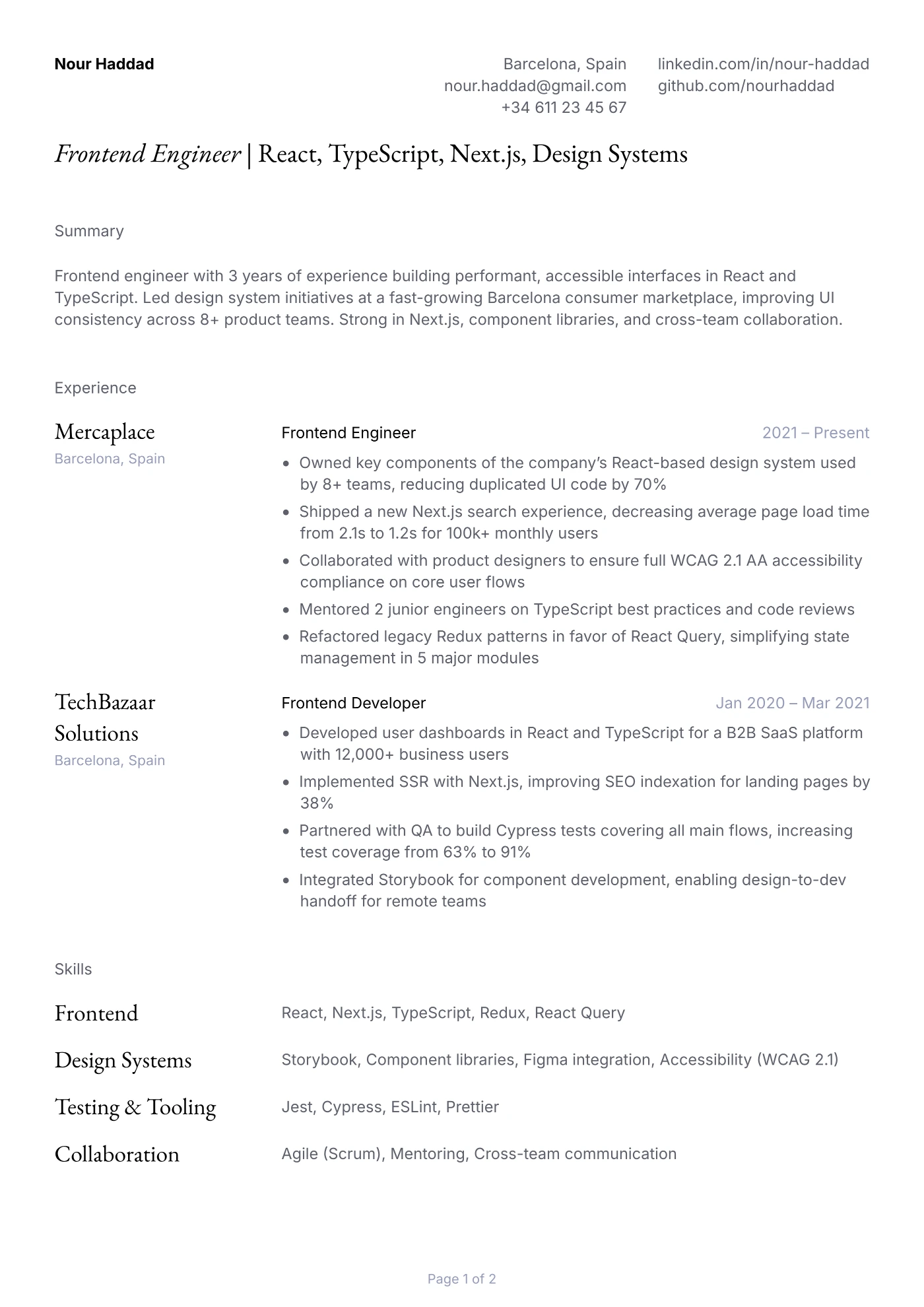
Mid-Level Frontend Engineer Resume Example
A mid-level frontend engineer resume example showing React, Next.js, and design system delivery. Ideal for consumer marketplace and product roles.
Why this works
- Clear metrics for design system impact
- Demonstrated accessibility expertise
- Next.js and SSR experience highlighted
- Mentoring and collaboration included
- Concise, achievement-focused bullet points
Mid-Level Frontend Engineer Resume: full text
Summary
Frontend engineer with 3 years of experience building performant, accessible interfaces in React and TypeScript. Led design system initiatives at a fast-growing Barcelona consumer marketplace, improving UI consistency across 8+ product teams. Strong in Next.js, component libraries, and cross-team collaboration.
Experience
Frontend Engineer
Mercaplace, Barcelona, Spain · 2021 – Present
- Owned key components of the company’s React-based design system used by 8+ teams, reducing duplicated UI code by 70%
- Shipped a new Next.js search experience, decreasing average page load time from 2.1s to 1.2s for 100k+ monthly users
- Collaborated with product designers to ensure full WCAG 2.1 AA accessibility compliance on core user flows
- Mentored 2 junior engineers on TypeScript best practices and code reviews
- Refactored legacy Redux patterns in favor of React Query, simplifying state management in 5 major modules
Frontend Developer
TechBazaar Solutions, Barcelona, Spain · Jan 2020 – Mar 2021
- Developed user dashboards in React and TypeScript for a B2B SaaS platform with 12,000+ business users
- Implemented SSR with Next.js, improving SEO indexation for landing pages by 38%
- Partnered with QA to build Cypress tests covering all main flows, increasing test coverage from 63% to 91%
- Integrated Storybook for component development, enabling design-to-dev handoff for remote teams
Skills
Frontend
React, Next.js, TypeScript, Redux, React Query
Design Systems
Storybook, Component libraries, Figma integration, Accessibility (WCAG 2.1)
Testing & Tooling
Jest, Cypress, ESLint, Prettier
Collaboration
Agile (Scrum), Mentoring, Cross-team communication
Education
BSc Computer Science
Universitat Pompeu Fabra · 2016 – 2020
- Graduated with honors, GPA 8.7/10
- Final project: Real-time event platform with React and Firebase
How to write a mid-level frontend engineer resume
Hiring managers for mid-level frontend engineer roles want clear evidence of technical depth in modern JavaScript frameworks, real impact on user experience, and the ability to collaborate across teams. Structure your resume to highlight hands-on contributions to production code, measurable improvements, and ownership of core UI initiatives.
Begin with a concise summary tailored to frontend engineering, followed by a detailed experience section emphasizing results using technologies like React, Next.js, and TypeScript. Quantify your achievements—such as performance gains or accessibility compliance—and list skills relevant to design systems, testing, and code quality. Keep education and side projects brief but relevant.
What skills should a frontend engineer put on a resume?
Showcase technical competencies and collaborative skills that align with frontend engineering at a product-focused company. Prioritize frameworks, accessibility, component libraries, and cross-functional communication.
- Frontend frameworks: React, Next.js, TypeScript, Redux, React Query
- Design systems: Storybook, component libraries, Figma integration, accessibility (WCAG 2.1)
- Testing & tooling: Jest, Cypress, ESLint, Prettier
- Collaboration: Agile methodologies (Scrum), code reviews, mentoring, cross-team communication
- Performance & SEO: Server-side rendering, page load optimization, SEO best practices
Frontend engineer resume bullet point examples
Use bullet points that demonstrate your technical impact, ownership, and ability to improve user experience or team efficiency. Quantify results and specify technologies where possible.
- Migrated 4 product areas from Redux to React Query, reducing average bug reports per quarter from 18 to 7
- Built a reusable modal system in React, cutting duplicated codebase by 1,200 lines across 6 teams
- Rolled out automated accessibility auditing, enabling the team to resolve 95% of critical issues pre-launch
- Launched SSR-enabled landing pages with Next.js, lifting organic search impressions from 22k to 51k/month
- Spearheaded a company-wide design token initiative, aligning UI branding across all web products without disrupting release cycles
Common mistakes on frontend engineer resumes
Avoid these pitfalls to ensure your frontend engineer resume stands out for the right reasons and accurately reflects your capabilities.
- Listing only technologies without context—always pair tools with results or project scope
- Ignoring accessibility—demonstrate understanding of WCAG or practical improvements for users
- Overlooking collaboration—show how you worked with product, design, or mentored others
- Neglecting performance metrics—quantify impact on loading times, SEO, or scalability
Frequently asked questions
How long should a mid-level frontend engineer resume be?
Aim for one page focused on recent, relevant experience. For mid-level roles, concise but detailed descriptions of your last 2–3 positions and a clear summary of your stack are more valuable than listing every project or tool used.
Should I include side projects or open source contributions?
Include side projects or open source contributions if they use relevant technologies (React, Next.js, TypeScript) or demonstrate skills not shown in your main roles, such as accessibility, design systems, or performance optimization. Keep each entry results-focused and brief.
How can I show leadership or ownership at the mid-level?
Highlight moments where you led initiatives (like rolling out a design system or mentoring juniors), owned major features, or took charge of cross-team collaboration. Use bullet points to describe your influence on processes, technical standards, or onboarding new tools.
Which keywords should I include to pass ATS for a frontend engineer role?
Include keywords like React, Next.js, TypeScript, component libraries, accessibility, WCAG 2.1, Jest, Cypress, Storybook, SSR, and Agile. Tailor your skills and achievements to match the stack and responsibilities listed in the job description for better ATS results.