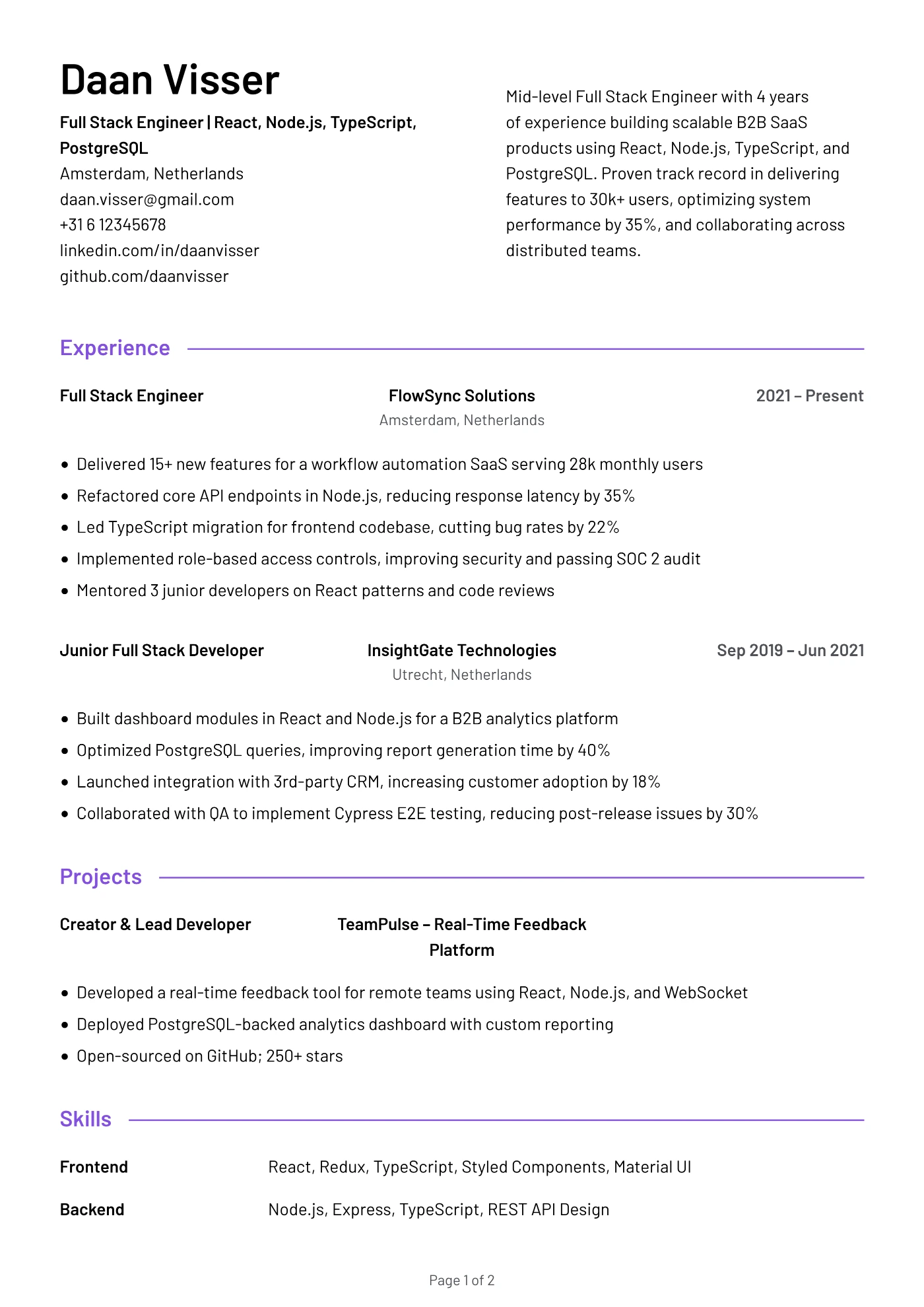
Mid-Level Full Stack Engineer Resume Example
A full stack engineer resume example with React, Node.js, and TypeScript in SaaS. Ideal for B2B product and scale-up roles.
Why this works
- Impact-first bullets with clear metrics
- Relevant stack for B2B SaaS companies
- Progression from junior to mid-level roles
- Grouped technical skills for fast scanning
- Concrete project example with open-source link
Mid-Level Full Stack Engineer Resume: full text
Summary
Full stack engineer who has spent 4 years building B2B SaaS products in React, Node.js, TypeScript and PostgreSQL. Shipped features for a workflow automation product with 28k monthly users, led its frontend move to TypeScript, and mentors junior developers.
Experience
Full Stack Engineer
FlowSync Solutions, Amsterdam, Netherlands · Jul 2021 – Present
- Shipped 15+ features for a workflow automation SaaS with 28k monthly users
- Rewrote the workflow list and run-history endpoints in Node.js; p95 latency dropped from 640 ms to 410 ms
- Led the frontend's migration from JavaScript to TypeScript, 400+ files over two quarters
- Added role-based access control across the app and API, one of the requirements for the company's SOC 2 audit
- Mentored 3 junior developers on React patterns and code reviews
Junior Full Stack Developer
InsightGate Technologies, Utrecht, Netherlands · Sep 2019 – Jun 2021
- Built dashboard modules in React and Node.js for a B2B analytics platform
- Moved report queries to PostgreSQL materialized views; the largest customer's monthly report went from 50 s to 12 s
- Built the integration with a third-party CRM, which sales asked for in most enterprise deals
- Set up Cypress end-to-end tests for the main report flows from the QA engineer's test plans, so regressions there were caught before release
Projects
TeamPulse – Real-Time Feedback Platform
Creator & Lead Developer
- Developed a real-time feedback tool for remote teams using React, Node.js, and WebSocket
- Deployed PostgreSQL-backed analytics dashboard with custom reporting
- Open-sourced on GitHub; 250+ stars
Skills
Frontend
React, Redux, TypeScript, Styled Components, Material UI
Backend
Node.js, Express, TypeScript, REST API Design
Database
PostgreSQL, Prisma, Knex.js
Testing
Jest, Cypress, React Testing Library
DevOps & Tooling
Docker, GitHub Actions, AWS (EC2, S3)
Education
BSc Computer Science
Vrije Universiteit Amsterdam · Sep 2016 – Jul 2019
- Graduated with Honours
- Capstone project: SaaS admin panel with React and Node.js
How to write a mid-level full stack engineer resume
Hiring managers for mid-level full stack engineer positions want to see hands-on experience shipping features in production, especially within modern SaaS environments. Your resume should highlight ownership of end-to-end projects, measurable impact on performance or reliability, and collaboration with product, design, and QA teams.
Structure your resume to emphasize both frontend and backend projects, using specific technology names (e.g., React, Node.js, PostgreSQL). Quantify your achievements—mention user base size, performance gains, or security improvements. Include mentoring junior developers or leading small initiatives to show readiness for increased responsibility.
What skills should a full stack engineer put on a resume?
A full stack engineer resume should show proficiency across both client and server, with supporting skills in database design, testing, and DevOps. Technical breadth is critical, but highlight depth in your primary stack and modern approaches to deployment and testing.
- Frontend: React, Redux, TypeScript, Styled Components, Material UI
- Backend: Node.js, Express, REST API design, TypeScript
- Database: PostgreSQL, Prisma, Knex.js
- Testing: Jest, Cypress, React Testing Library
- DevOps & CI/CD: Docker, GitHub Actions, AWS (EC2, S3)
Full stack engineer resume bullet point examples
Use action-oriented bullet points that demonstrate your impact and technical range. Metrics and context help hiring managers understand your contributions.
- Built automated deployment pipeline with GitHub Actions and Docker, decreasing release times by 40%
- Migrated legacy JavaScript frontend to React + TypeScript, reducing critical errors by 25%
- Designed and implemented RESTful APIs with Express and PostgreSQL, supporting 20k+ daily active users
- Integrated third-party authentication via OAuth2, streamlining onboarding and improving security compliance
- Collaborated with QA to establish Cypress-based regression suite, catching 95% of high-priority bugs before release
Common mistakes on full stack engineer resumes
Mid-level full stack applicants often overlook project scope or fail to highlight measurable impact. Ensure your resume avoids these common pitfalls:
- Listing technologies without context—always specify project or feature use
- Neglecting to quantify results—include metrics like user count or performance gains
- Overemphasizing frontend or backend—balance both sides of the stack
- Omitting collaboration or mentoring—show teamwork and leadership potential
Frequently asked questions
How long should a mid-level full stack engineer resume be?
One page is ideal for mid-level full stack engineers with up to 5 years’ experience. Prioritize impactful projects, relevant technologies, and quantifiable outcomes. If you have extensive side projects or notable achievements, a second page is acceptable but avoid filler.
Should I include personal or open-source projects on my resume?
Yes, list open-source or personal projects if they use your core stack (e.g., React, Node.js, PostgreSQL) and demonstrate real users, adoption, or technical complexity. Projects with public code or measurable impact (stars, contributors) add credibility and practical depth.
How do I show leadership on a mid-level engineering resume?
Highlight experiences where you mentored junior developers, led code reviews, or spearheaded migrations or feature launches. Focus on instances where your guidance improved processes, code quality, or team performance—even if you didn’t have a formal leadership title.
What keywords or technologies are most important to include?
Emphasize your main stack: React, Node.js, TypeScript, PostgreSQL. Also include related tools like Docker, GitHub Actions, Prisma, and testing frameworks (Jest, Cypress). Mention SaaS, REST APIs, and any relevant security or compliance experience to align with B2B product requirements.