Software engineer resume bullet points: a formula and examples by role
· 8 min read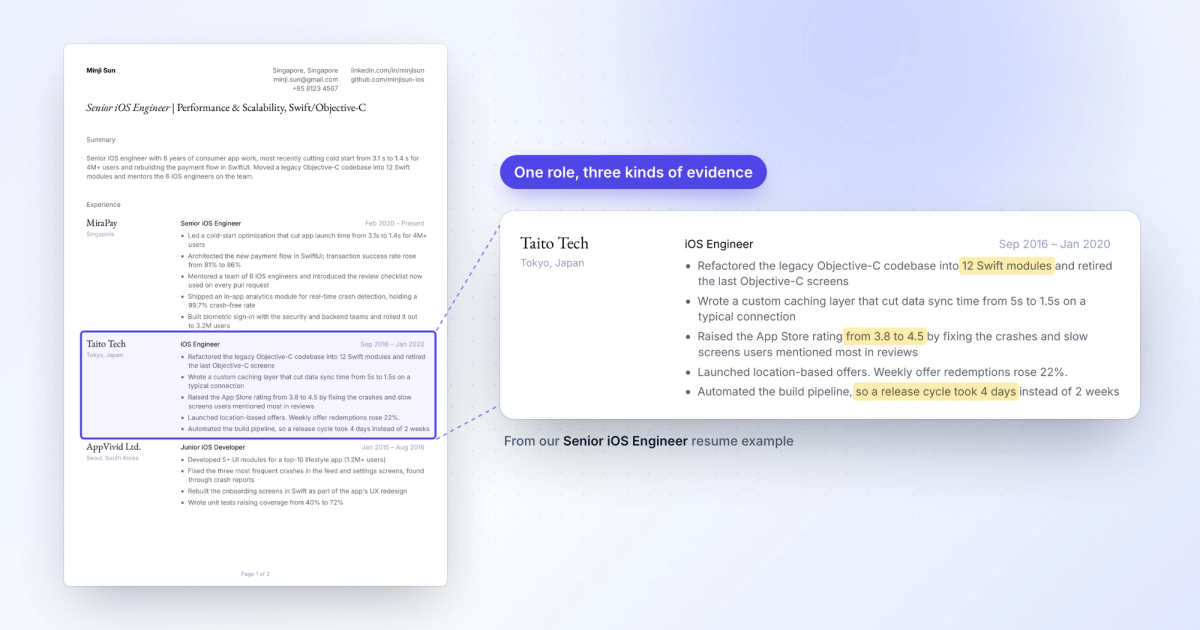
A good software engineer resume bullet says what you did, to which system, and what changed because of it: "Cut Android cold start from 2.8 s to 1.1 s by deferring analytics SDK initialization." Use a plain verb and name the system. The result should be something a technical reader can ask you about in an interview.
This post gives weak-to-strong rewrites for frontend, backend, iOS, DevOps and fintech work, and covers the bullets the usual formula does not fit.
What makes a software engineer resume bullet strong?
A strong bullet has an action, the work it was applied to, and an outcome. The action is a verb for what you actually did. The work is a named system, service or feature, not "the platform". The outcome is what changed: a number, or something that no longer happens.
The XYZ formula is the best-known version of this. It is usually credited to Laszlo Bock, who described it while he was head of people operations at Google, and it reads "Accomplished X, as measured by Y, by doing Z." It works well when you have a before and after value. We recommend treating it as a checklist rather than a sentence template, because a page where every bullet opens with a result and ends with "by doing" reads as generated.
Before:
- Worked on the CI pipeline and helped make builds faster
After:
- Rebuilt the CI/CD pipelines in GitHub Actions, replacing Jenkins, and cut a typical build from 24 to 9 minutes
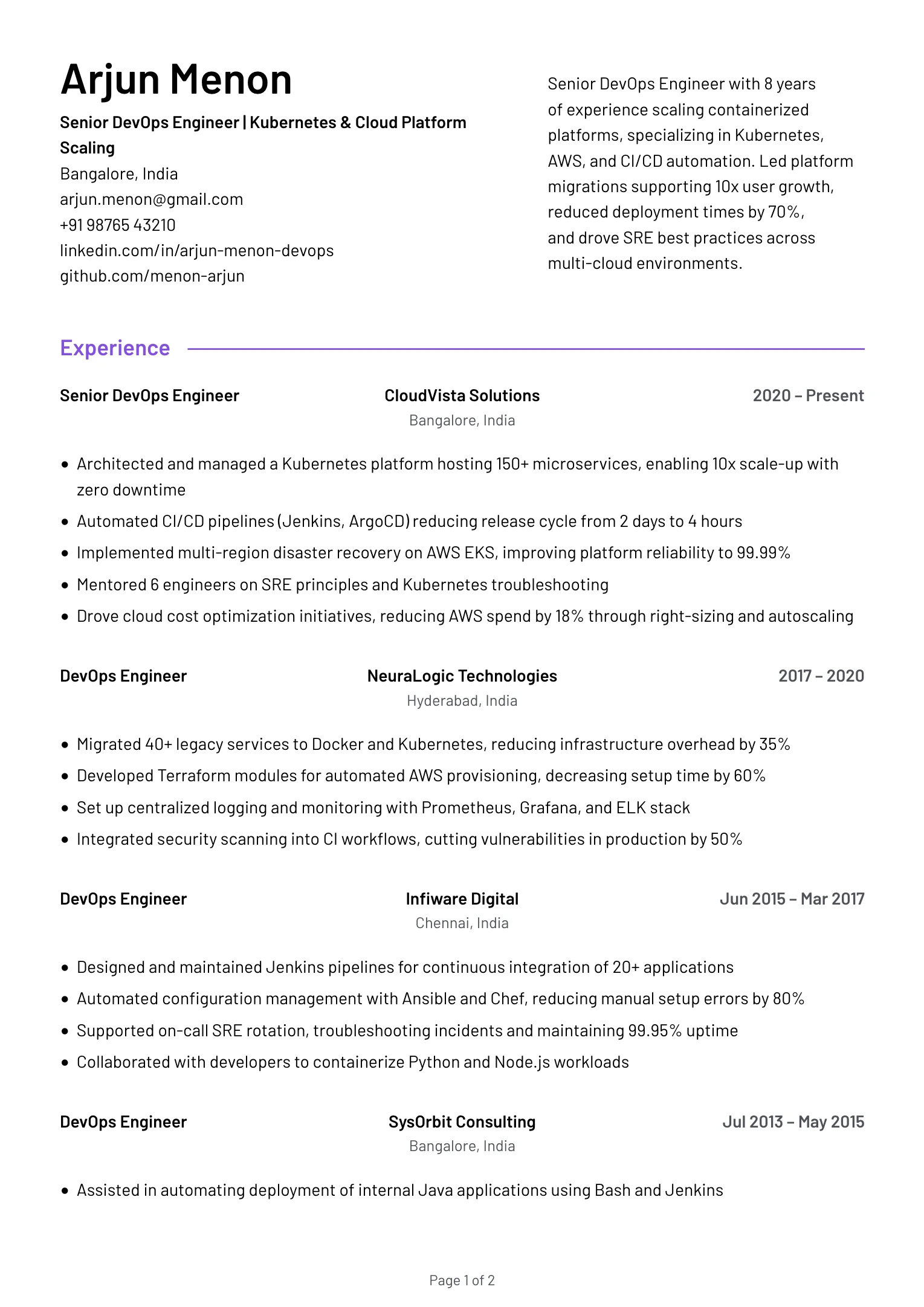
The "After" line is from our mid-level DevOps example, shown in full further down. It names the old tool, the new one, and a number you could explain.
The snippets below are bullets only. A full role with its company, title and dates appears in the iOS section.
Frontend and backend bullet examples
Frontend results are usually measured in the browser: load time, bundle size, Core Web Vitals, accessibility audits, and how many teams use what you built. For a checkout team at an e-commerce company:
Before:
- Responsible for the checkout page and performance improvements
- Helped with the component library
After:
- Split the checkout bundle by route, so the payment step loads 180 KB of gzipped JavaScript instead of 640 KB
- Built the date picker and data table in the React component library now used by four product teams
- Fixed keyboard navigation and focus order in checkout, the last WCAG 2.1 AA failures in the accessibility audit
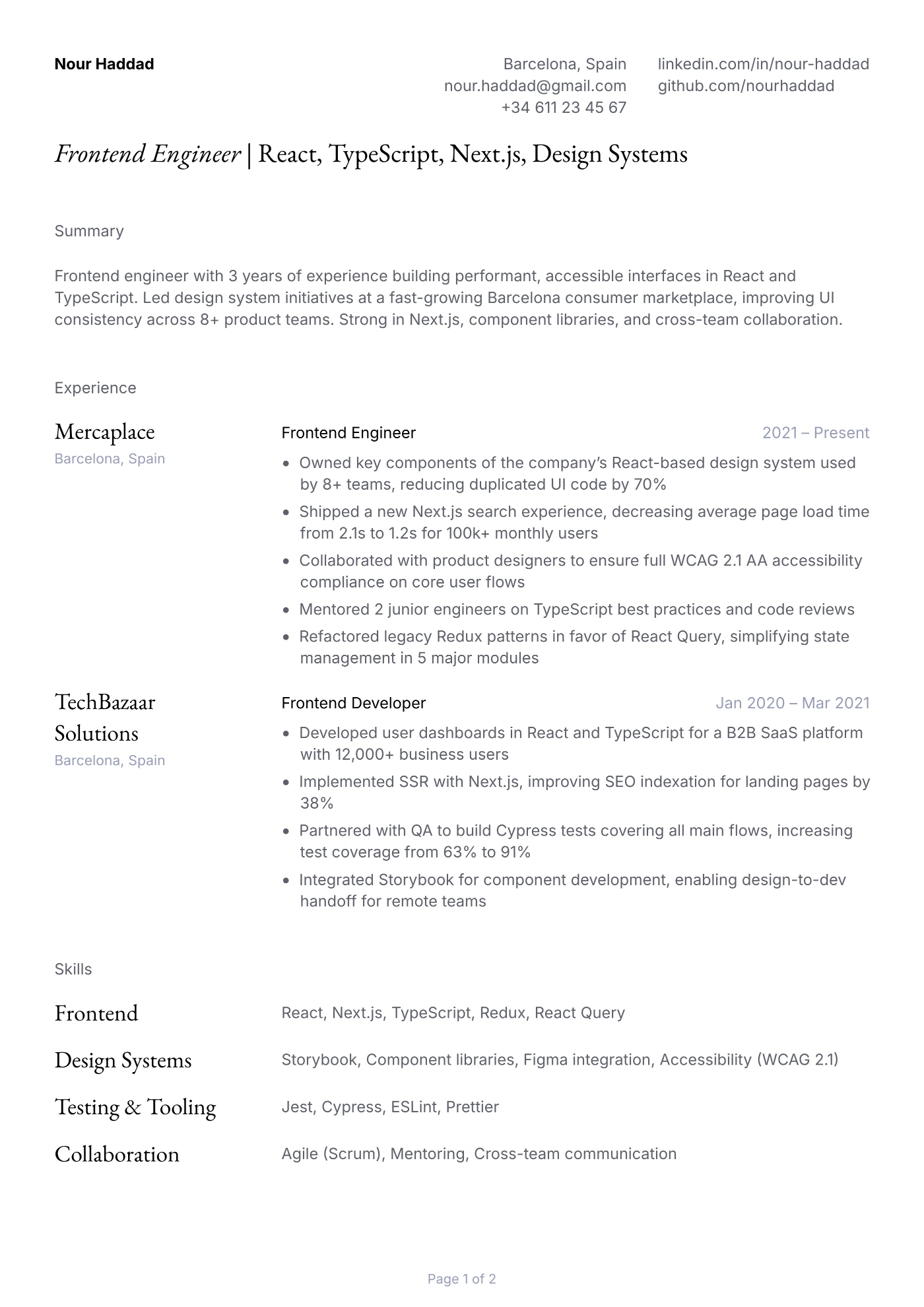
The last bullet has no number. It names a standard the reader can check, which does the same job. Our mid-level frontend engineer example uses a scope bullet in the same way, for a design system used by eight product teams.
Backend bullets have more kinds of evidence than the latency figure most guides use. Data size, throughput, removed failure modes and retired systems are often more interesting.
Before:
- Worked on migrating the orders database
After:
- Moved 2.3 TB of order history from MySQL to PostgreSQL using dual writes and a staged cutover; the API stayed up throughout
- Replaced the nightly batch export with a Kafka consumer, so partners see order changes within a minute instead of the next morning
- On-call for the orders service, one week in five
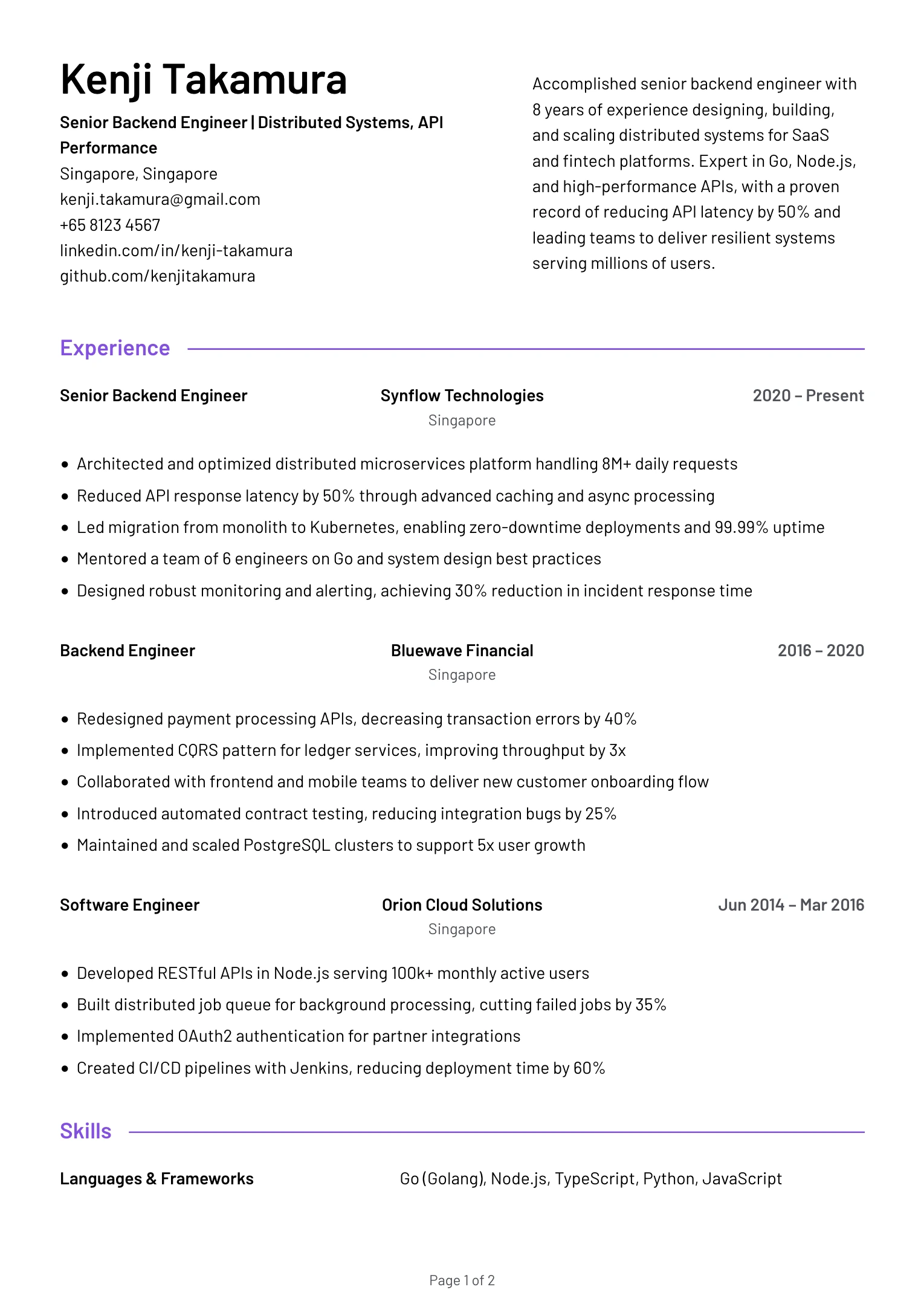
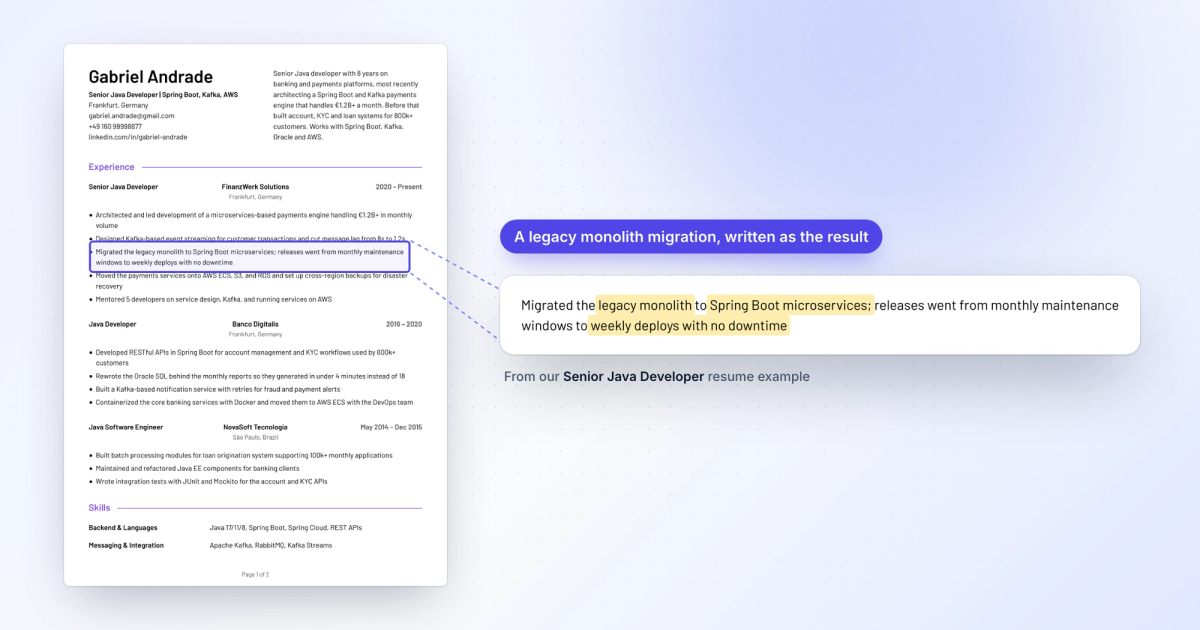
The senior backend engineer example states a result without any number: "Led the move from the monolith to services on Kubernetes, so deploys no longer take the API offline."
iOS and mobile bullet examples
Mobile engineers have good numbers available and often forget them. Your crash reporter records crash-free sessions. Xcode Organizer shows launch time, and App Store Connect has the rating history and every release date.
Three of the five bullets from one role in our senior iOS engineer example:
Taito Tech, Tokyo, Japan
iOS Engineer | Sep 2016 – Jan 2020
- Refactored the legacy Objective-C codebase into 12 Swift modules and retired the last Objective-C screens
- Raised the App Store rating from 3.8 to 4.5 by fixing the crashes and slow screens users mentioned most in reviews
- Automated the build pipeline, so a release cycle took 4 days instead of 2 weeks
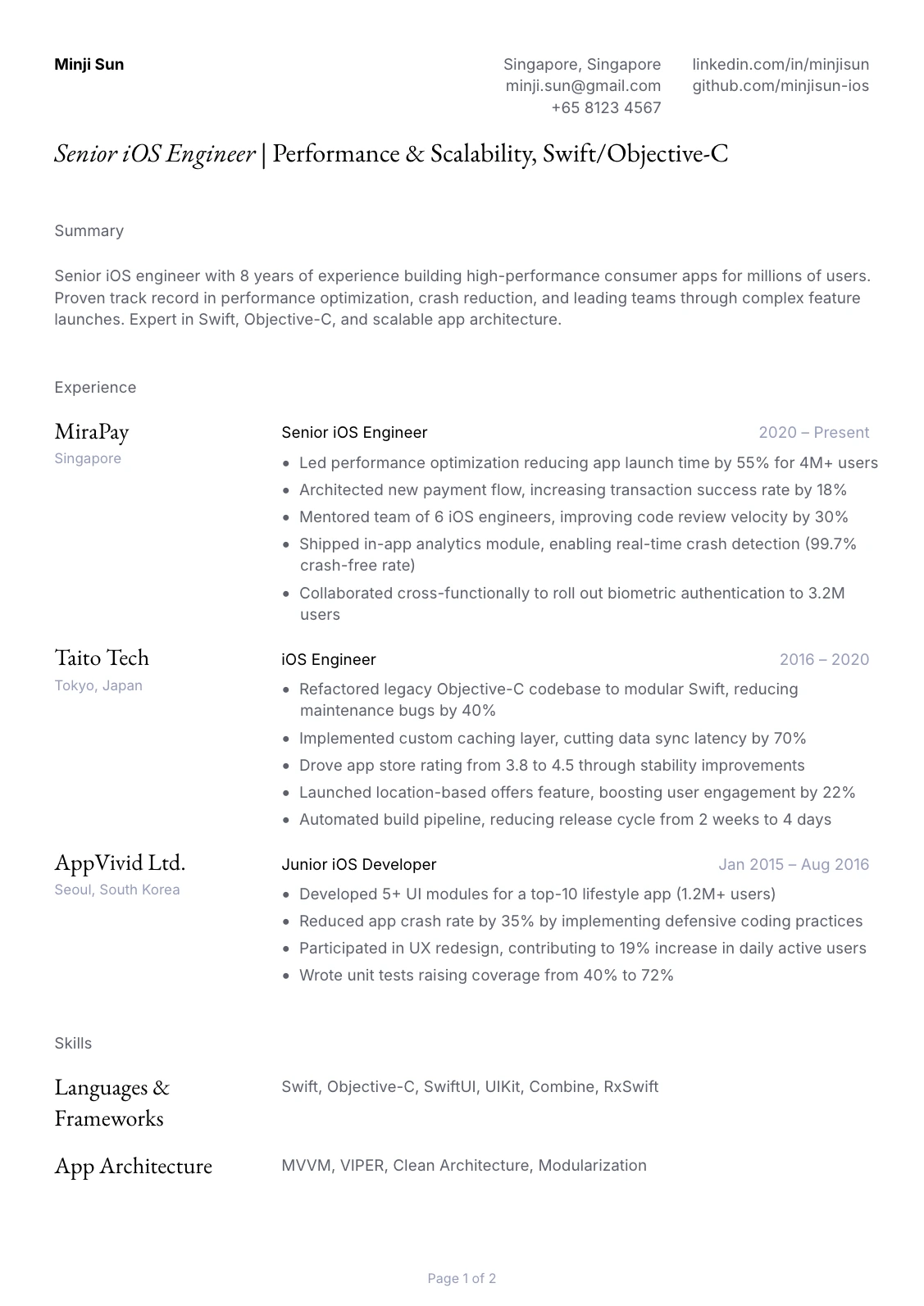
Senior iOS Engineer Resume Example
The Taito Tech role: a count, a before and after rating, and a "so" result
View the full example
The first bullet is scope. The second gives a before and after value, and the third states its result with "so". None of them repeats the shape of the one above it.
DevOps and cloud bullet examples
DevOps and platform work is easy to measure, because pipeline duration, deploy frequency, cloud cost and recovery time are all recorded somewhere. The usual mistake is listing every tool without saying what changed.
Before:
- Utilized Terraform, AWS, Prometheus, Grafana, GitHub Actions and Docker in daily work
After:
- Migrated 11 on-premise applications to AWS ECS and cut monthly infrastructure spend from $38k to $27k
- Developed the Terraform modules for VPC and ECS provisioning that all 6 product teams use to create environments
- Set up centralized monitoring with Prometheus and Grafana and wrote the on-call runbooks for the platform team
These are from the Krestonix Technologies role in our mid-level DevOps engineer example. Each tool from the "Before" line now sits next to the work it did. The full list of tools belongs in the skills section, and the post on where to put your tech stack covers how to split it.
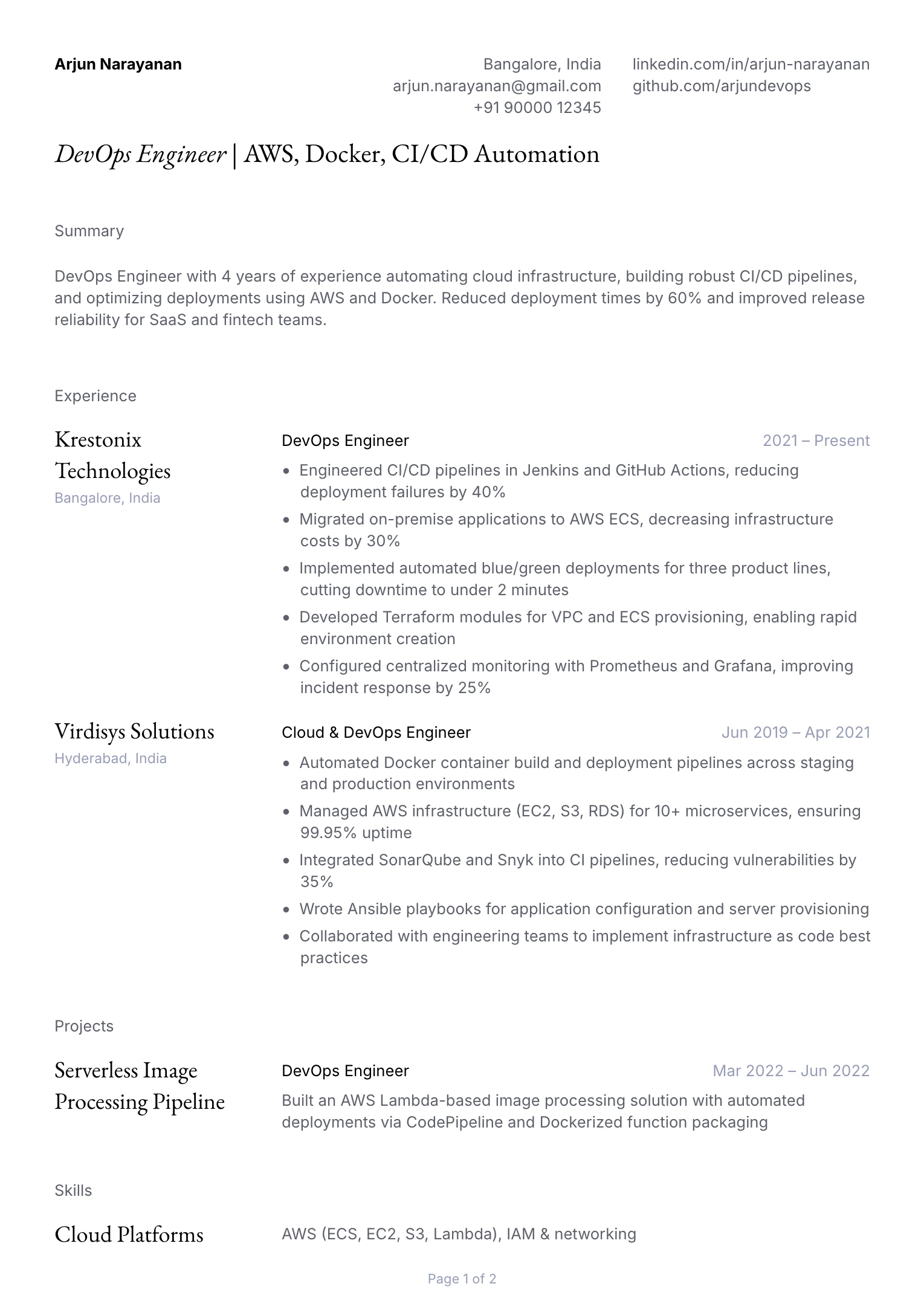
Mid-Level DevOps Engineer Resume Example
The Krestonix role: cost, team count and scope in one role
View the full example
Bullets for fintech and other regulated work
In fintech, healthcare and other regulated industries, much of the real engineering is about controls: audit trails, reconciliation, data retention, and keeping systems out of scope for an assessment. Generic advice pushes you toward revenue or conversion numbers, but a payments engineer rarely owns those numbers alone.
We recommend writing about the control and what it changed in the system. A reader from another fintech will recognize it.
Before:
- Helped the team with PCI compliance work
After:
- Moved card data from the main database into a tokenization service, so 3 of 40 services remain in PCI DSS scope
- Built the nightly job that reconciles 1.2M card transactions against the processor's settlement files and sends mismatches to the finance team
- Added audit logging for every change to a customer's payout details
You can say that you closed an audit finding. Leave out what the finding was, and do not mention fines or incidents that were not made public. The post on internal tools and confidential work covers how much detail to give.
Where the XYZ formula does not work
The formula assumes a measurable before and after. Much good engineering work has neither, and forcing a number onto it produces bullets like "improved code quality by 30%", which nobody can explain in an interview.
No metric was recorded. Describe scope instead: what you built, how big it is, who depends on it, what it replaced. The longer answer, including where to find numbers after the fact, is in how to write bullets with no metrics.
Maintenance and upgrades. Framework upgrades, dependency updates and on-call keep a product running and rarely produce a large number. Say what was upgraded, how much of it, and why it mattered at the time.
- Upgraded 14 services from Spring Boot 2.7 to 3.2 before the 2.7 line lost open-source support
- Removed 9 unused feature flags and the code paths behind them from the billing service
The post on on-call and maintenance work has more of these.
Team outcomes. Most large results come from a team. Claiming the whole result for yourself is a common credibility problem, and an interviewer will find it with one question about your part. Name your part and the team's result in the same bullet.
Before:
- Launched the new mobile banking app to 500k users
After:
- Built the card controls and transaction history screens for the new banking app, which a team of 8 rolled out to 500k existing customers
If you led the work, say so and give the size of the team. For leadership without the title, see technical leadership without a management title.
Which verbs to stop using on a resume
Avoid these openers:
Before:
- Worked on the payments API
- Helped migrate the payments API to Go
- Responsible for refunds and payouts
- Utilized Go and PostgreSQL to build payout endpoints
- Spearheaded the payments modernization initiative
After:
- Owned the payments API and rewrote its refund and payout endpoints in Go
- Moved payout state from a shared MySQL table into its own PostgreSQL schema
"Worked on" and "helped" hide what you did. The third opener describes a job description instead of work. The fourth is a longer way to write "used", and usually the tool name alone is enough. Inflated verbs like the last one often make a technical reader suspect the bullet was generated or exaggerated.
Use the verb for what actually happened: built, wrote, added, moved, replaced, removed, fixed, cut, owned, ran, shipped. Use "led" only for a project or a group of people whose size you state.
How many bullets per job, and how long?
For your current or most recent role, we recommend four to six bullets. For the role before it, three to five. For roles more than about ten years back, one or two, or only the title and dates. The post on resume length covers how this adds up across a page.
Keep each bullet to one line where you can and two at most. A bullet that runs to three lines usually holds two achievements, so split it. Mix lengths within a role: put a short bullet like "On-call for the orders service, one week in five" next to a longer one with a result.
Two situations change the count. If you were promoted at one company, the bullets are split across the titles, and the most recent title gets most of them; see how to show a promotion. If you are a contractor with several short engagements, two or three bullets per client is usually enough, and the UK contractor CV post shows how to group them.
Put it into practice
Build your resume in Filiz and watch the PDF update as you edit. Start from scratch, import your current resume, or begin with an example. No sign-up needed to try it.
Frequently asked questions
What is the XYZ formula for a resume?
It is a pattern for a bullet: "Accomplished X, as measured by Y, by doing Z." X is the result, Y is the number that shows it, and Z is the work you did. Use it when you have a real before and after value, and change the sentence shape from bullet to bullet.
How many bullets should each job have?
Four to six for your current or most recent role, three to five for the one before, and one or two for roles from more than about ten years ago. If a role has only two things worth saying, two bullets is enough. Promotions and short contracts change the count, as described above.
How long should a bullet be?
One line where possible and two lines at most at the width of a normal template. A bullet that runs to three lines usually contains two achievements and should become two bullets. Short bullets with no result are fine next to longer ones.
Should I use past or present tense?
Past tense for earlier roles. For your current role, we recommend past tense for work that is finished ("Rebuilt the CI pipeline") and present tense for what you still do ("Own the payments API"). Pick the rule and apply it to every bullet in the role. Never use first person.
Should every bullet have a number?
No. Use a number when one exists and you can explain it in an interview. When there is none, describe the scope: what you built, how large it is, who depends on it, or what it replaced. Do not write a number you could not explain if asked.