Junior Data Scientist Resume Example
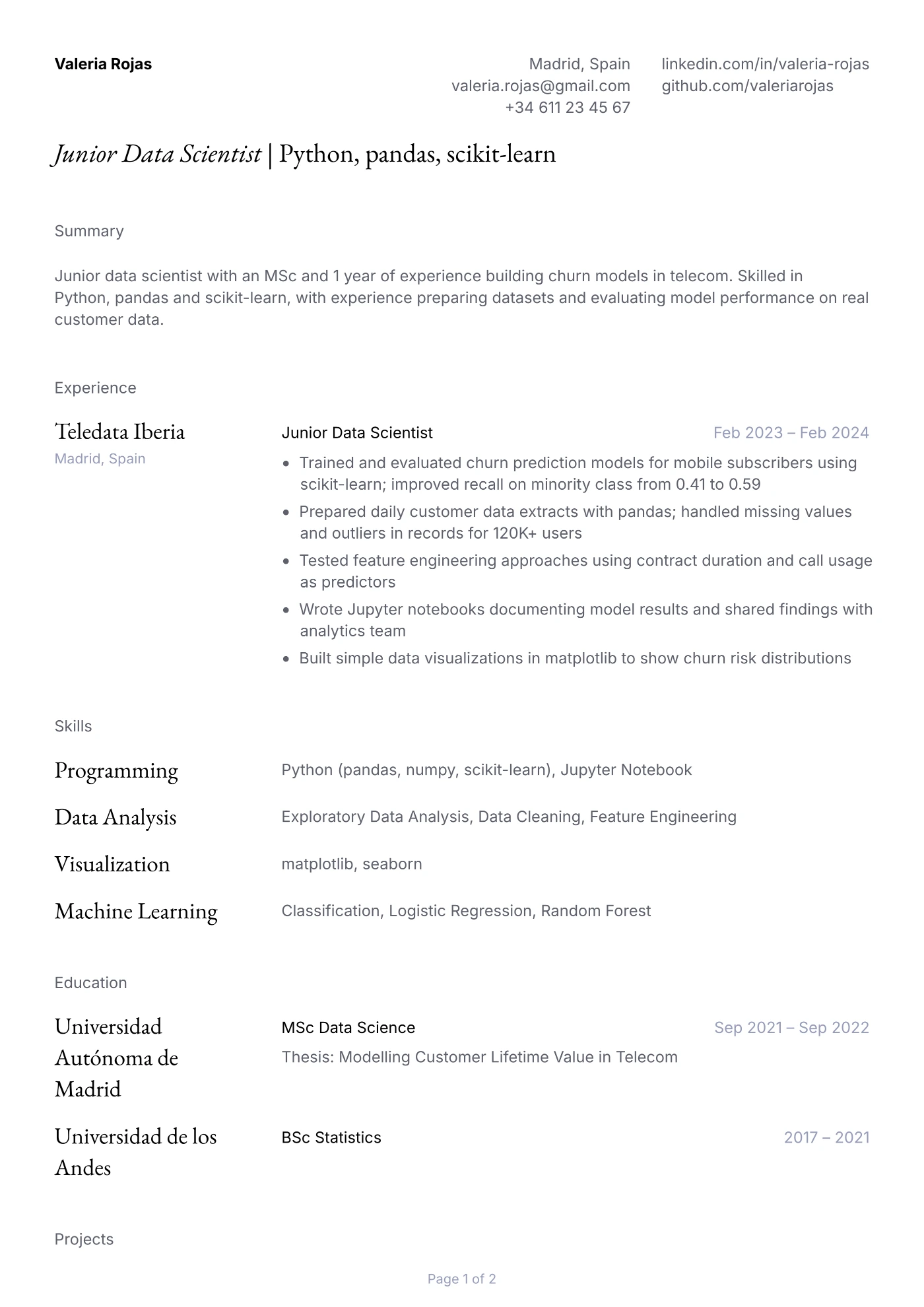
A junior data scientist resume example with real-world churn modelling and clean Python skills. For telecom, analytics and entry-level ML roles.
Why this works
- Specific before-and-after model metrics
- Clear Python, pandas, scikit-learn stack
- Education with project-based thesis
- Personal project with public code
- Plain, concrete bullet style
Junior Data Scientist Resume: full text
Summary
Junior data scientist with an MSc and 1 year of experience building churn models in telecom. Skilled in Python, pandas and scikit-learn, with experience preparing datasets and evaluating model performance on real customer data.
Experience
Junior Data Scientist
Teledata Iberia, Madrid, Spain · Feb 2023 – Feb 2024
- Trained and evaluated churn prediction models for mobile subscribers using scikit-learn; improved recall on minority class from 0.41 to 0.59
- Prepared daily customer data extracts with pandas; handled missing values and outliers in records for 120K+ users
- Tested feature engineering approaches using contract duration and call usage as predictors
- Wrote Jupyter notebooks documenting model results and shared findings with analytics team
- Built simple data visualizations in matplotlib to show churn risk distributions
Skills
Programming
Python (pandas, numpy, scikit-learn), Jupyter Notebook
Data Analysis
Exploratory Data Analysis, Data Cleaning, Feature Engineering
Visualization
matplotlib, seaborn
Machine Learning
Classification, Logistic Regression, Random Forest
Education
MSc Data Science
Universidad Autónoma de Madrid · Sep 2021 – Sep 2022
Thesis: Modelling Customer Lifetime Value in Telecom
BSc Statistics
Universidad de los Andes · Aug 2017 – Jun 2021
Projects
Churn Prediction Demo
Personal Project
- Built a churn prediction pipeline with pandas and scikit-learn on public telecom data
- Compared logistic regression, random forest and XGBoost models; best ROC-AUC: 0.87
- Published code and notebook with step-by-step explanation
How to write a junior data scientist resume
Show your practical experience with real data and Python-based tools, even if your projects are small or academic. Hiring managers look for evidence you can prepare messy datasets, train models, and communicate findings clearly. Focus on what you built and the impact, not just listing tools.
Structure the page with a summary, experience section naming concrete tasks or models, a concise skills list, and relevant education or projects. For junior roles, highlight hands-on work with datasets, model evaluation, and any business context for your analyses. Use numbers and model metrics wherever possible.
What skills should a data scientist put on a resume?
Highlight skills in data cleaning, feature engineering, and training machine learning models. Show you can use Python libraries and communicate insights with code and visuals. Group your skills for clarity.
- Programming: Python, pandas, numpy, scikit-learn, Jupyter Notebook
- Data wrangling: data cleaning, handling missing values, outlier detection
- Modeling: classification, regression, logistic regression, random forest
- Visualization: matplotlib, seaborn, basic charting for model explanation
- Evaluation: recall, precision, ROC-AUC, cross-validation
Data scientist resume bullet point examples
Bullets should show what you built, analyzed, or improved, naming technologies and model metrics. Use clear before-and-after results or describe the scale of data handled.
- Improved precision on test set from 0.51 to 0.66 by tuning random forest hyperparameters in scikit-learn
- Processed monthly records for 150K+ subscribers to analyze churn trends across four regions
- Added contract type and payment history as features; best model ROC-AUC increased from 0.72 to 0.81
- Replaced manual data checks with automated pandas scripts to validate daily data loads
- Built and shared matplotlib plots to visualize churn risk by customer segment for the marketing team
Common mistakes on data scientist resumes
Many junior data scientist resumes are hard to read because they only list coursework or tools. Avoid these issues by focusing on hands-on contributions and outcomes.
- Listing every Python library instead of those actually used on real data
- Describing academic projects without mentioning dataset size or results
- Using vague terms like 'analyzed data' instead of naming the analysis or outcome
- Leaving out evaluation metrics or business impact in machine learning results
Frequently asked questions
How long should a junior data scientist resume be?
Keep it to one page. Focus on your most relevant projects, internships, and technical skills. Remove unrelated work history unless it clearly connects to data work. Hiring managers want to see practical ability, not filler.
Should I include side projects or Kaggle competitions?
Yes, if you trained real models, handled nontrivial data, or published code, include these. Briefly describe what you did and any model performance metrics. Side projects can show initiative and practical skill, which matter at the junior level.
How do I show impact if I only worked on academic projects?
Quantify results where possible: dataset size, model metrics (accuracy, recall, ROC-AUC), or what the analysis enabled. Explain how you cleaned, engineered, or validated data. Show you can move from raw data to a usable model or insight.
Which keywords matter most for a junior data scientist resume?
Name Python, pandas, and scikit-learn if you used them. List core tasks—data cleaning, feature engineering, classification, model evaluation. Mention visualization tools like matplotlib. Employers scan for evidence you can handle real datasets and deliver practical results.