Mid-Level AI Engineer Resume Example
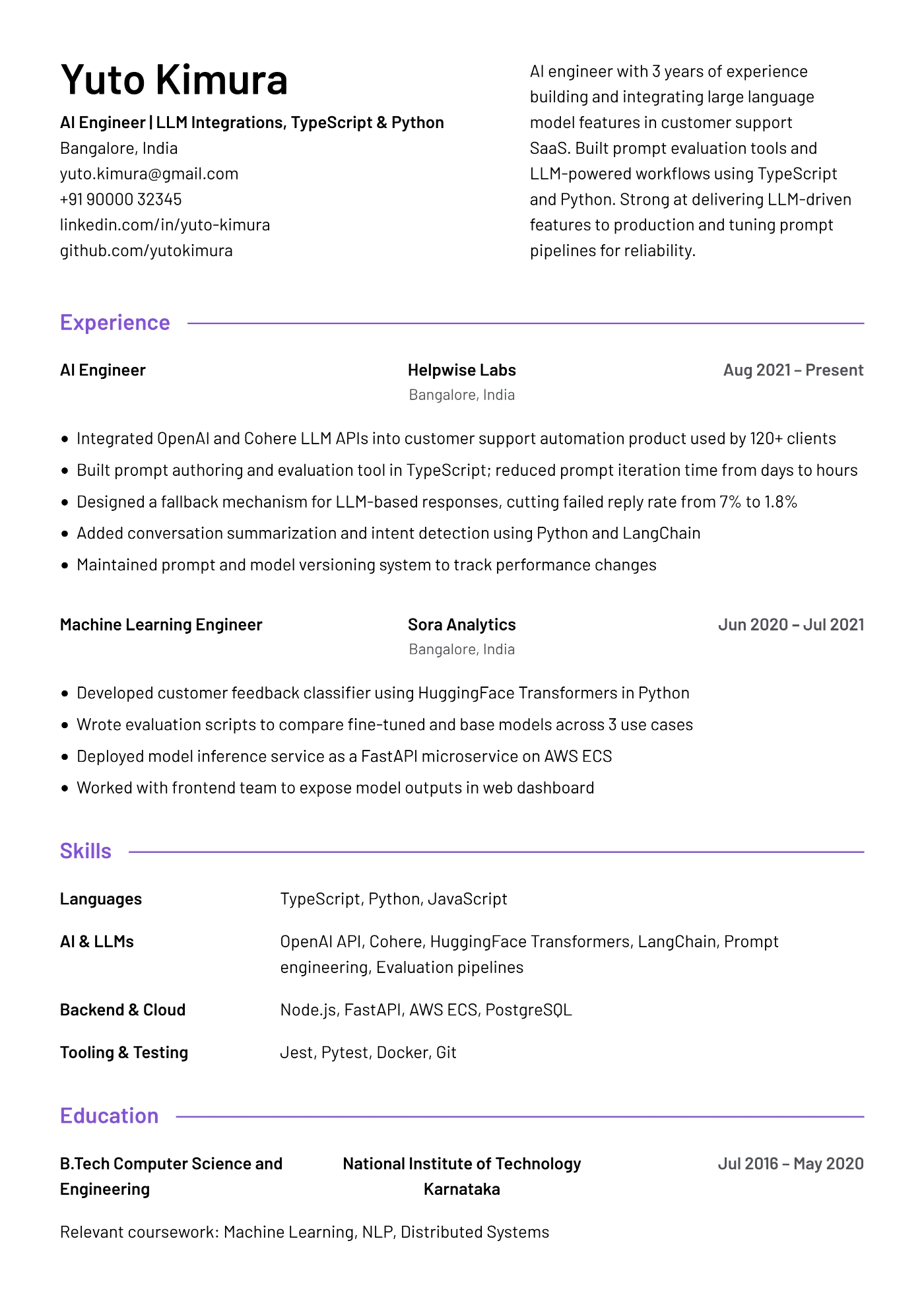
A mid-level AI engineer resume with LLM integrations, prompt evaluation, and Python/TypeScript. For customer support and SaaS ML roles.
Why this works
- Specific LLM integration and tooling examples
- Concrete before-and-after reliability results
- Both Python and TypeScript work shown
- Clear education and ML coursework listed
- Metrics on product and client usage
Mid-Level AI Engineer Resume: full text
Summary
AI engineer with 3 years of experience building and integrating large language model features in customer support SaaS. Built prompt evaluation tools and LLM-powered workflows using TypeScript and Python. Strong at delivering LLM-driven features to production and tuning prompt pipelines for reliability.
Experience
AI Engineer
Helpwise Labs, Bangalore, India · Aug 2021 – Present
- Integrated OpenAI and Cohere LLM APIs into customer support automation product used by 120+ clients
- Built prompt authoring and evaluation tool in TypeScript; reduced prompt iteration time from days to hours
- Designed a fallback mechanism for LLM-based responses, cutting failed reply rate from 7% to 1.8%
- Added conversation summarization and intent detection using Python and LangChain
- Maintained prompt and model versioning system to track performance changes
Machine Learning Engineer
Sora Analytics, Bangalore, India · Jun 2020 – Jul 2021
- Developed customer feedback classifier using HuggingFace Transformers in Python
- Wrote evaluation scripts to compare fine-tuned and base models across 3 use cases
- Deployed model inference service as a FastAPI microservice on AWS ECS
- Worked with frontend team to expose model outputs in web dashboard
Skills
Languages
TypeScript, Python, JavaScript
AI & LLMs
OpenAI API, Cohere, HuggingFace Transformers, LangChain, Prompt engineering, Evaluation pipelines
Backend & Cloud
Node.js, FastAPI, AWS ECS, PostgreSQL
Tooling & Testing
Jest, Pytest, Docker, Git
Education
B.Tech Computer Science and Engineering
National Institute of Technology Karnataka · Jul 2016 – May 2020
Relevant coursework: Machine Learning, NLP, Distributed Systems
How to write a mid-level AI engineer resume
Show direct experience with production LLM features and prompt pipelines. Hiring managers for AI engineer roles want to see shipped features, specific APIs or models, and quantifiable impact. For a mid-level role, describe how you own individual features or subsystems, not just assist in projects.
Structure your resume with a summary, then experience ordered by relevance and recency. List skills and tools by category. Under experience, lead each bullet with your contribution and follow with outcomes or metrics. Use the skills section to clarify your stack and AI toolkits.
What skills should an AI engineer put on a resume?
Prioritize skills in modern LLMs and AI API integration, plus supporting backend and testing tools. List practical experience with prompt engineering, model evaluation, and workflow automation. Emphasize languages and frameworks you use to build, ship, and monitor AI features.
- LLM APIs and frameworks: OpenAI API, Cohere, HuggingFace Transformers, LangChain
- Languages: Python, TypeScript, JavaScript
- Backend and deployment: FastAPI, Node.js, Docker, AWS ECS, PostgreSQL
- Prompt engineering and evaluation: prompt authoring, pipeline tuning, evaluation scripts
- Testing and versioning: Pytest, Jest, Git, prompt/model version control
AI engineer resume bullet point examples
Format each bullet with a concrete action, what you built or improved, and the evidence or outcome. Numbers, before/after states, or explicit features help hiring managers gauge your experience level.
- Built an LLM-powered auto-tagging workflow in Python, reducing manual triage time from 45 minutes per 100 tickets to under 10 minutes
- Integrated new OpenAI GPT-4 endpoints, raising conversation summarization accuracy from 82% to 91% on internal benchmarks
- Migrated prompt evaluation scripts from ad hoc Python to a maintained TypeScript tool, so non-engineers could run batch tests
- Added model performance dashboards tracking fallback rates and version drift across 120 customer accounts
- Replaced manual prompt iteration with an automated testing pipeline, cutting total prompt tuning time by 70%
Common mistakes on AI engineer resumes
AI engineer resumes often miss key project specifics or overstate generic ML skills. Avoid listing every tool you have touched or making vague claims about "AI impact". Show exactly what you built, the stack, and concrete results.
- Listing all ML frameworks used instead of focusing on those shipped to production
- Describing "AI projects" without naming the LLM, API, or workflow you built
- Claiming prompt engineering experience but not stating evaluation or tuning process
- Leaving out deployment or monitoring details for AI/LLM features
Frequently asked questions
How long should a mid-level AI engineer resume be?
One page is standard for mid-level AI engineers. Focus on shipped AI features, real impact, and concrete skills. If you include early internships or minor projects, keep them brief and make your core LLM experience most visible.
Should I include side projects or open source on my AI engineer resume?
Include side projects only if they use LLMs or demonstrate production-level AI work. Open source contributions to relevant libraries like HuggingFace or LangChain are valuable, but describe your contribution and outcome, not just the repo name.
How do I show ownership or leadership as a mid-level AI engineer?
Show ownership by naming features or subsystems you designed, implemented, or maintained. List prompt pipelines, evaluation tools, or fallback logic you built. If you enabled non-engineers or handled a release, say so concretely in a bullet.
Which keywords matter most for an AI engineer resume in LLMs?
Mention OpenAI API, Cohere, HuggingFace Transformers, prompt engineering, evaluation pipelines, and LangChain if you have used them. Also include Python, TypeScript, FastAPI, and AWS ECS to show backend and deployment skills for production LLM features.