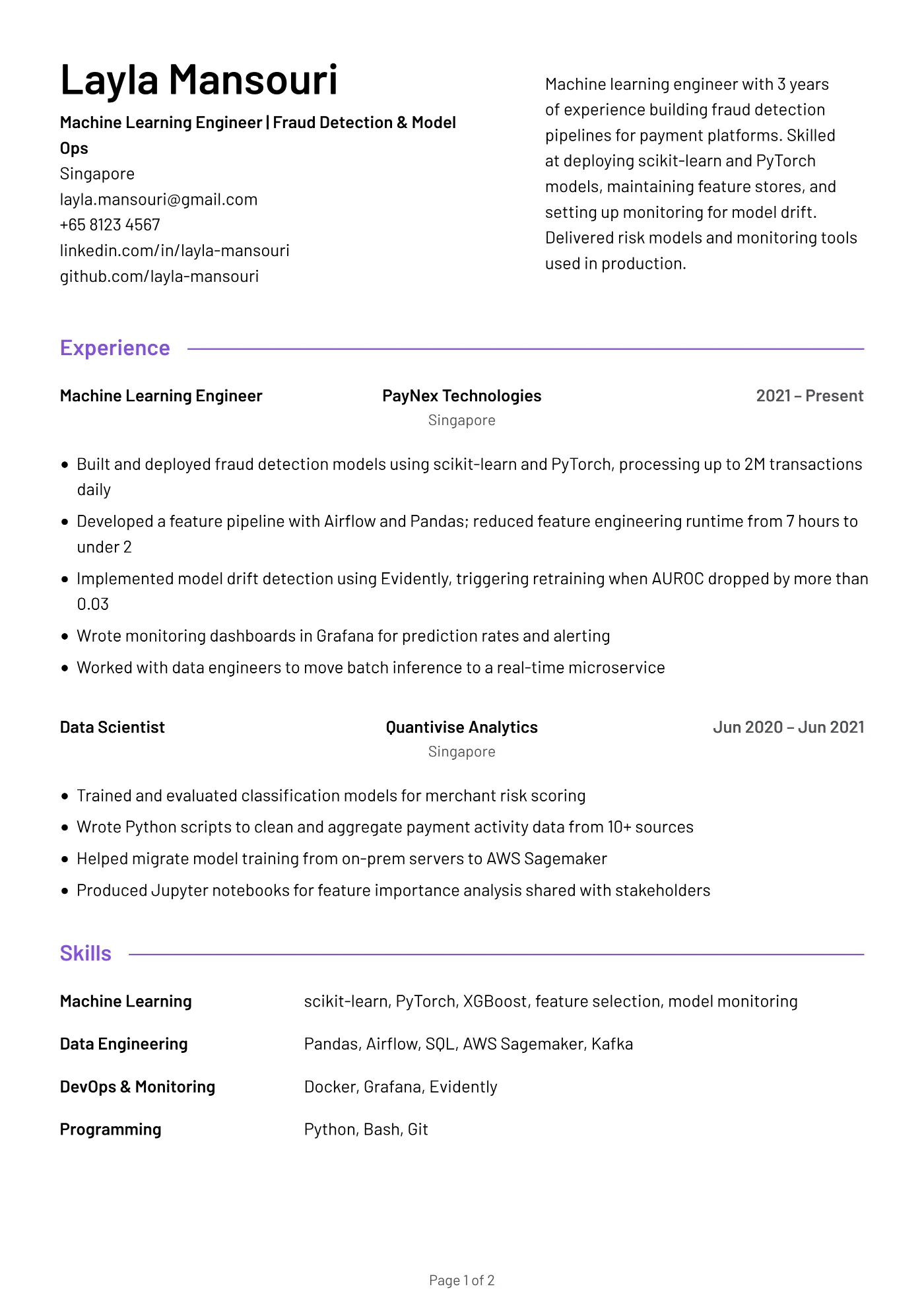
Mid-Level Machine Learning Engineer Resume Example
A mid-level machine learning engineer resume for fraud detection and model ops. Ideal for fintech or payments data teams using Python and PyTorch.
Why this works
- Feature pipeline and monitoring achievements
- Concrete model deployment results
- Clear before-and-after runtime numbers
- Skills grouped by real workflow
- Education matches domain and stack
Mid-Level Machine Learning Engineer Resume: full text
Summary
Machine learning engineer with 3 years of experience building fraud detection pipelines for payment platforms. Skilled at deploying scikit-learn and PyTorch models, maintaining feature stores, and setting up monitoring for model drift. Delivered risk models and monitoring tools used in production.
Experience
Machine Learning Engineer
PayNex Technologies, Singapore · 2021 – Present
- Built and deployed fraud detection models using scikit-learn and PyTorch, processing up to 2M transactions daily
- Developed a feature pipeline with Airflow and Pandas; reduced feature engineering runtime from 7 hours to under 2
- Implemented model drift detection using Evidently, triggering retraining when AUROC dropped by more than 0.03
- Wrote monitoring dashboards in Grafana for prediction rates and alerting
- Worked with data engineers to move batch inference to a real-time microservice
Data Scientist
Quantivise Analytics, Singapore · Jun 2020 – Jun 2021
- Trained and evaluated classification models for merchant risk scoring
- Wrote Python scripts to clean and aggregate payment activity data from 10+ sources
- Helped migrate model training from on-prem servers to AWS Sagemaker
- Produced Jupyter notebooks for feature importance analysis shared with stakeholders
Skills
Machine Learning
scikit-learn, PyTorch, XGBoost, feature selection, model monitoring
Data Engineering
Pandas, Airflow, SQL, AWS Sagemaker, Kafka
DevOps & Monitoring
Docker, Grafana, Evidently
Programming
Python, Bash, Git
Education
BSc Computer Science
National University of Singapore · 2016 – 2020
Final year project: Transaction anomaly detection using neural networks
How to write a mid-level machine learning engineer resume
Show that you can train, deploy, and monitor models at production scale. Name the volume and type of data you’ve worked with and give concrete results—like latency reduction, drift handling, or error rate drops. Mention specific ML and data tools you used and any production experience.
Structure your resume clearly: summary, experience, skills, education. For each job, make the scope clear (data size, model type, deployment setup). Use bullet points that focus on outcomes, not just tasks. Highlight monitoring, model lifecycle, and any cross-team work with data or engineering groups.
What skills should a machine learning engineer put on a resume?
List skills that show you can own the full ML workflow—data collection, feature engineering, model training, deployment, and monitoring. Technical details matter: name frameworks, orchestration tools, and monitoring stacks. Show both ML and data engineering fluency.
- Machine learning frameworks: scikit-learn, PyTorch, XGBoost
- Feature engineering and pipelines: Pandas, Airflow, feature stores
- Model deployment and monitoring: Docker, Grafana, Evidently, AWS Sagemaker
- Data engineering: SQL, Kafka, batch and real-time processing
- Programming and scripting: Python, Bash, Git
Machine learning engineer resume bullet point examples
Use bullet points that quantify your impact or show the scale of your work. Describe how you improved, replaced, or maintained ML systems or pipelines. Show you can identify and fix bottlenecks, automate processes, and handle real production workloads.
- Cut model prediction latency from 600ms to 180ms by switching inference to a TorchScript-optimized service
- Processed 3M+ daily payment events by building a Kafka-based streaming feature pipeline
- Wrote an Airflow DAG to automate weekly model retraining; replaced manual steps and reduced errors
- Added Grafana alerts for feature distribution shifts, so data issues surface within minutes instead of hours
- Moved fraud detection from batch to real-time scoring for all card transactions
Common mistakes on machine learning engineer resumes
Avoid vague descriptions and inflated claims. Hiring managers look for specifics about tools, data, and the business impact of your work. Don’t leave out monitoring or deployment details—production experience is key.
- Listing only model training—add deployment and monitoring details to show end-to-end ownership
- Leaving out data scale—state how many records, transactions, or features you handled
- Writing generic skills—tie each skill to a concrete project or result
- Ignoring non-ML engineering work—show work on pipelines, infrastructure, and automation
Frequently asked questions
How long should a mid-level machine learning engineer resume be?
Keep it to one page if you have less than 6 years of experience. Focus on relevant ML, data engineering, and deployment work. Only add a second page if you have strong research or major project experience that directly fits the role.
Should I list side projects or Kaggle competitions?
If your side projects or Kaggle work show real ML engineering skills—deployment, data pipelines, or writing reusable code—list them in a separate section. Only include projects with depth or results, not just tutorials or coursework.
How do I show leadership or ownership at the mid level?
Show ownership by naming systems you maintained, improved, or migrated—like moving a model to real-time inference or setting up monitoring alerts. Mention if you led projects, automated workflows, or mentored others, even informally.
Which keywords matter most for machine learning engineering roles?
Keywords like scikit-learn, PyTorch, feature engineering, Airflow, model deployment, monitoring, and real-time inference are important. Also name infrastructure tools (Kafka, Docker, Grafana) and cloud services (AWS Sagemaker) if you have hands-on experience. Tie each keyword to a result or real project.