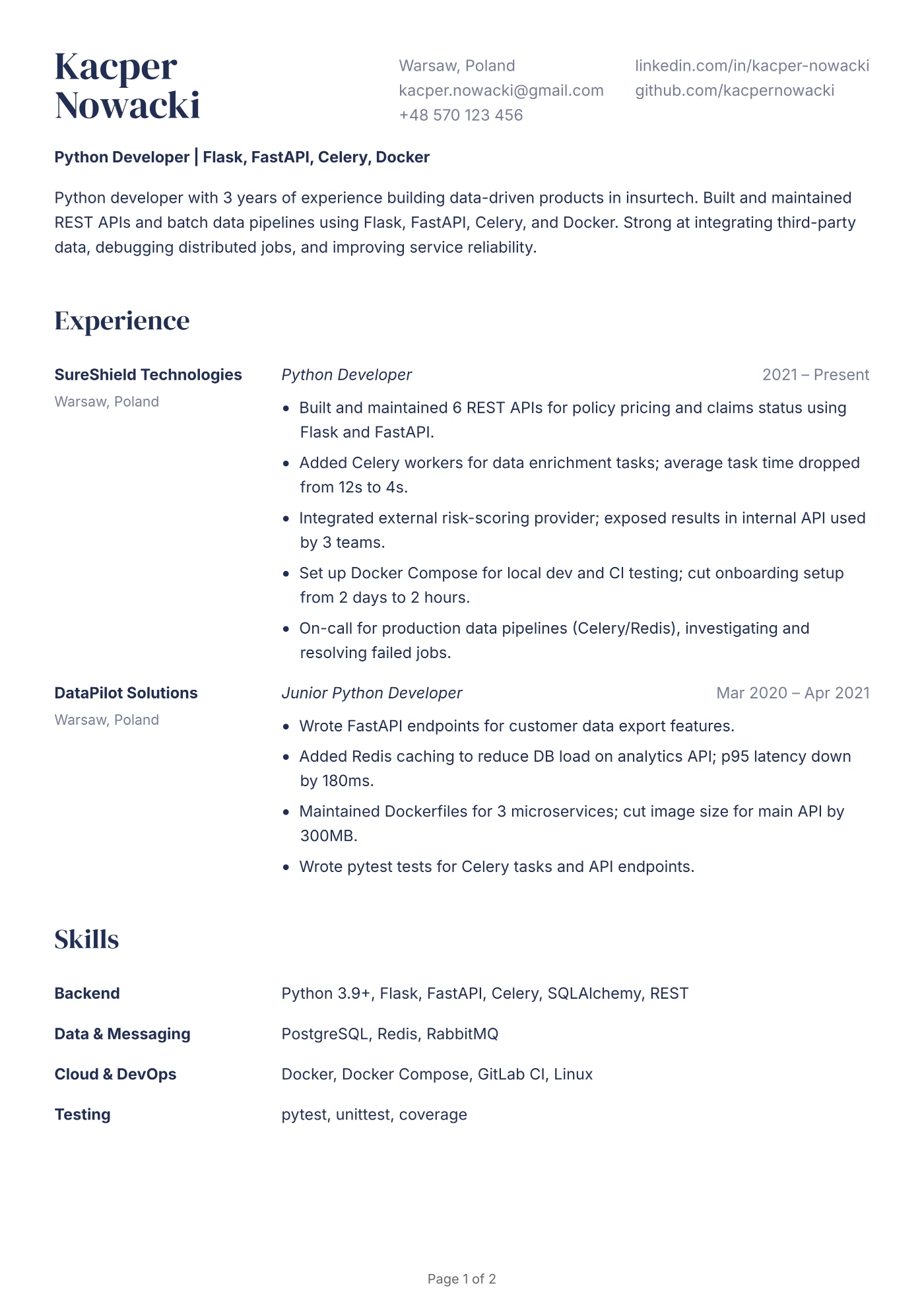
Mid-Level Python Developer Resume Example
A mid-level Python developer resume for data products in insurtech. Good fit for Flask, FastAPI, and Celery roles.
Why this works
- Plain numbers on API and job performance
- Modern Python stack with Docker and Celery
- Three years in insurance tech environments
- Evidence of improving developer experience
- Testing and on-call experience included
Mid-Level Python Developer Resume: full text
Summary
Python developer with 3 years of experience building data-driven products in insurtech. Built and maintained REST APIs and batch data pipelines using Flask, FastAPI, Celery, and Docker. Strong at integrating third-party data, debugging distributed jobs, and improving service reliability.
Experience
Python Developer
SureShield Technologies, Warsaw, Poland · 2021 – Present
- Built and maintained 6 REST APIs for policy pricing and claims status using Flask and FastAPI.
- Added Celery workers for data enrichment tasks; average task time dropped from 12s to 4s.
- Integrated external risk-scoring provider; exposed results in internal API used by 3 teams.
- Set up Docker Compose for local dev and CI testing; cut onboarding setup from 2 days to 2 hours.
- On-call for production data pipelines (Celery/Redis), investigating and resolving failed jobs.
Junior Python Developer
DataPilot Solutions, Warsaw, Poland · Mar 2020 – Apr 2021
- Wrote FastAPI endpoints for customer data export features.
- Added Redis caching to reduce DB load on analytics API; p95 latency down by 180ms.
- Maintained Dockerfiles for 3 microservices; cut image size for main API by 300MB.
- Wrote pytest tests for Celery tasks and API endpoints.
Skills
Backend
Python 3.9+, Flask, FastAPI, Celery, SQLAlchemy, REST
Data & Messaging
PostgreSQL, Redis, RabbitMQ
Cloud & DevOps
Docker, Docker Compose, GitLab CI, Linux
Testing
pytest, unittest, coverage
Education
BSc Computer Science
Warsaw University of Technology · 2016 – 2020
- Thesis: Automated claims validation with Python
- Coursework: Data Structures, Distributed Systems, Databases
How to write a mid-level Python developer resume
Show projects and features you built using Python frameworks like Flask, FastAPI, and Celery. Hiring managers look for clear evidence you can design, implement, and support APIs, automate data tasks, and improve reliability at production scale. Give concrete examples of the services, APIs, and pipelines you owned, and the business value or technical impact.
Organize your resume by recent roles, naming the stack, scale, and your contributions. Two or three sentences in the summary should cover your focus area, tech strengths, and the biggest thing you built or improved. In the experience section, use bullet points to detail what you built or fixed, naming real tools and outcomes.
What skills should a Python developer put on a resume?
List frameworks, messaging systems, and dev tools you use for building APIs and data pipelines. Show you know how to work with distributed systems, containerization, and testing. Group your skills by area to show depth and relevance.
- Web frameworks: Flask, FastAPI, Django
- Task queues and messaging: Celery, Redis, RabbitMQ
- Databases and ORMs: PostgreSQL, SQLAlchemy, MySQL
- Containerization and CI: Docker, Docker Compose, GitLab CI, GitHub Actions
- Testing: pytest, unittest, coverage
- Monitoring and debugging: Sentry, logging, metrics tools
Python developer resume bullet point examples
Good bullets combine a change you made, the technology used, and a result. Use numbers where possible to show scale or impact, but scope and ownership matter just as much.
- Migrated policy lookup API from Flask to FastAPI; average response time dropped from 220ms to 110ms.
- Wrote Celery workflow to batch-import partner claims data; processed 50,000+ records nightly without manual intervention.
- Replaced custom config loader with environment-based setup; cut deployment errors in CI to zero.
- Integrated RabbitMQ for async notifications, supporting 4 internal services.
- Documented and enforced API versioning across 6 endpoints to prevent breaking changes for frontend consumers.
Common mistakes on Python developer resumes
Most mistakes are about vague claims, missing stack details, or unclear scope. Be specific about your work, name tools, and show the impact or scale of what you built or improved.
- Listing 'REST APIs' without naming frameworks, leaving your real expertise unclear.
- Not mentioning the size or purpose of data pipelines or queues you worked on.
- Vague process claims like 'improved onboarding' without showing how or by how much.
- Forgetting to mention on-call or debugging experience for production systems.
Frequently asked questions
How long should a mid-level Python developer resume be?
Keep your resume to one page focusing on roles from the past 3–5 years. Only add earlier experience if it shows relevant skills or technologies. Use concise bullet points with focus on achievements and the real stack you worked with.
Should I list side projects or certifications on my Python developer resume?
List side projects if they use similar frameworks, APIs, or data pipelines to your target roles, and you can show real outcomes. Certifications only help if they match the tools in the job description—otherwise, focus on shipped code and production impact.
How do I show leadership or ownership at mid-level?
Show ownership by naming APIs, features, or systems you maintained or improved. Mention being on-call, handling incidents, or leading small migrations or integrations. Impact on reliability, onboarding, or developer workflow also signals ownership at this level.
What keywords matter most for a Python developer applying to insurtech or similar backend roles?
Include the main frameworks and tools: Python 3.x, Flask, FastAPI, Celery, Docker, REST, PostgreSQL, Redis, and CI/CD tools. For insurtech or data-driven companies, also mention data pipeline work, API integrations, and experience with external providers or complex business logic.