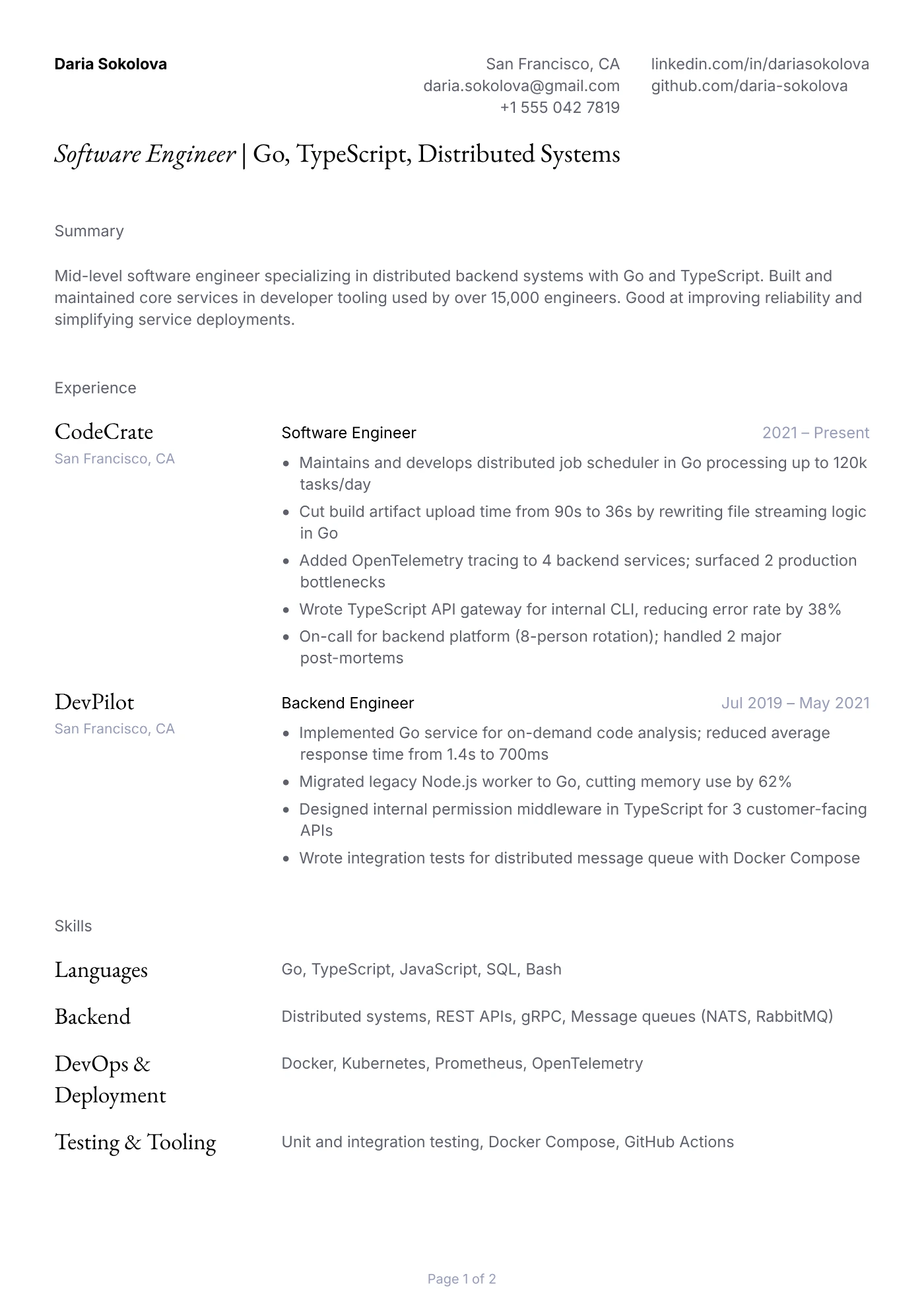
Mid-Level Software Engineer Resume Example
A mid-level software engineer resume for Go, TypeScript, and distributed systems. Useful for developer tooling roles and backend-focused teams.
Why this works
- Specific numbers on latency and throughput
- Plain language on distributed systems work
- Clear scope for each project and bullet
- On-call and incident experience included
- Grouped skills by relevant backend domains
Mid-Level Software Engineer Resume: full text
Summary
Mid-level software engineer specializing in distributed backend systems with Go and TypeScript. Built and maintained core services in developer tooling used by over 15,000 engineers. Good at improving reliability and simplifying service deployments.
Experience
Software Engineer
CodeCrate, San Francisco, CA · 2021 – Present
- Maintains and develops distributed job scheduler in Go processing up to 120k tasks/day
- Cut build artifact upload time from 90s to 36s by rewriting file streaming logic in Go
- Added OpenTelemetry tracing to 4 backend services; surfaced 2 production bottlenecks
- Wrote TypeScript API gateway for internal CLI, reducing error rate by 38%
- On-call for backend platform (8-person rotation); handled 2 major post-mortems
Backend Engineer
DevPilot, San Francisco, CA · Jul 2019 – May 2021
- Implemented Go service for on-demand code analysis; reduced average response time from 1.4s to 700ms
- Migrated legacy Node.js worker to Go, cutting memory use by 62%
- Designed internal permission middleware in TypeScript for 3 customer-facing APIs
- Wrote integration tests for distributed message queue with Docker Compose
Skills
Languages
Go, TypeScript, JavaScript, SQL, Bash
Backend
Distributed systems, REST APIs, gRPC, Message queues (NATS, RabbitMQ)
DevOps & Deployment
Docker, Kubernetes, Prometheus, OpenTelemetry
Testing & Tooling
Unit and integration testing, Docker Compose, GitHub Actions
Education
BSc Computer Science
Charles University · 2016 – 2019
- Thesis on distributed log processing
- Relevant coursework: Algorithms, Operating Systems, Distributed Systems
How to write a mid-level software engineer resume
Show clear evidence that you have built, owned, and improved backend systems at real scale. Mid-level means you can independently take a feature or service from design to production and production support. Hiring managers want to see specifics: the stack, the scale, and the impact of your work.
Structure your resume by company and role, with bullets under each that focus on outcomes, not just responsibilities. Quantify results where possible (latency, error rate, throughput) and name the technologies you used. For this level, showing experience with production incidents and post-mortems is a plus.
What skills should a software engineer put on a resume?
List the technologies you have used to build or support production systems. For a backend-focused software engineer, focus on distributed systems, observability, deployment, and the languages in your stack. Show you can deliver reliable services and work across the development lifecycle.
- Languages: Go, TypeScript, JavaScript, SQL, Bash
- Backend systems: Distributed processing, REST/gRPC APIs, message queues (NATS, RabbitMQ)
- DevOps & Observability: Docker, Kubernetes, Prometheus, OpenTelemetry
- Testing: Unit testing, integration testing, Docker Compose, GitHub Actions
- Deployment: CI/CD pipelines, containerized microservices
Software engineer resume bullet point examples
Show the effect of your work by naming before-and-after values, scale handled, or the system improved. Each bullet should describe what you changed, what tool or method you used, and what happened as a result.
- Reduced deployment rollback time from 20 minutes to 7 minutes by automating rollback scripts in Bash
- Handled on-call for Go-based platform; identified and fixed a recurring memory leak affecting 9,000+ daily jobs
- Cut API error rate by 41% by refactoring input validation in TypeScript gateway
- Built distributed metrics exporter in Go for 5 backend services; enabled service-level dashboards in Prometheus
- Migrated CLI authentication flow to gRPC, removing a legacy REST endpoint and simplifying client logic
Common mistakes on software engineer resumes
Avoid vague statements about teamwork or passion. Instead, state what you did and what changed. Focus on outcomes that matter for backend systems and distributed services. Show that you understand the production environment and have worked at the required scale.
- Omitting concrete metrics; always mention latency, throughput, error rates, or user scale where possible
- Listing every technology ever touched; stick to tools you have used in production
- Writing only responsibilities, not outcomes; hiring managers want to see impact
- Leaving out production support or on-call experience when you have it
Frequently asked questions
How long should a mid-level software engineer resume be?
Keep it to one page if you have less than 7 years of experience. Focus on recent roles, production experience, and measurable results. Remove older or unrelated projects.
Should I include side projects or open source on my resume?
Only include side projects or open source if they use the same stack or show skills at similar scale to your main experience. Name the project, your role, and the outcome. Prioritize production work first.
How do I show leadership or ownership at mid-level?
Describe features or services you built and maintained end-to-end. Mention on-call rotations, post-mortems you led, or processes you improved. Ownership at this level means running part of the system, not just contributing code.
Which keywords matter most for backend-focused roles?
Highlight Go, TypeScript, distributed systems, Docker, Kubernetes, message queues, and observability tools like Prometheus and OpenTelemetry. Also mention production metrics (latency, error rate, throughput) and CI/CD experience.