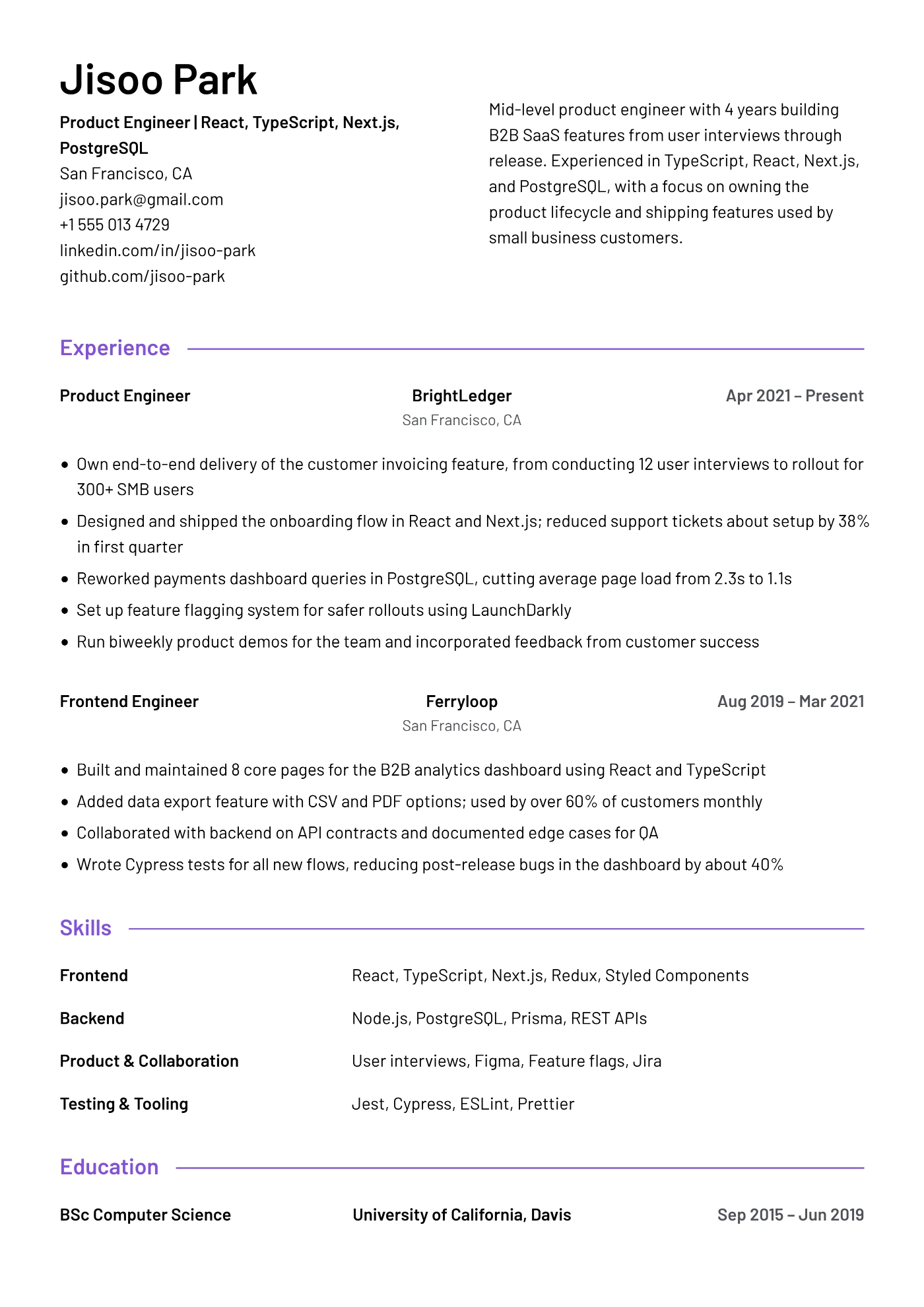
Mid-Level Product Engineer Resume Example
A mid-level product engineer resume showing feature ownership from interviews to release. For B2B SaaS and React/TypeScript roles.
Why this works
- End-to-end feature examples with user impact
- Concrete metrics on support and performance
- Clear ownership of product lifecycle
- Stack grouped by frontend, backend, product
- Education and experience both included
Mid-Level Product Engineer Resume: full text
Summary
Mid-level product engineer with 4 years building B2B SaaS features from user interviews through release. Experienced in TypeScript, React, Next.js, and PostgreSQL, with a focus on owning the product lifecycle and shipping features used by small business customers.
Experience
Product Engineer
BrightLedger, San Francisco, CA · Apr 2021 – Present
- Own end-to-end delivery of the customer invoicing feature, from conducting 12 user interviews to rollout for 300+ SMB users
- Designed and shipped the onboarding flow in React and Next.js; reduced support tickets about setup by 38% in first quarter
- Reworked payments dashboard queries in PostgreSQL, cutting average page load from 2.3s to 1.1s
- Set up feature flagging system for safer rollouts using LaunchDarkly
- Run biweekly product demos for the team and incorporated feedback from customer success
Frontend Engineer
Ferryloop, San Francisco, CA · Aug 2019 – Mar 2021
- Built and maintained 8 core pages for the B2B analytics dashboard using React and TypeScript
- Added data export feature with CSV and PDF options; used by over 60% of customers monthly
- Collaborated with backend on API contracts and documented edge cases for QA
- Wrote Cypress tests for all new flows, reducing post-release bugs in the dashboard by about 40%
Skills
Frontend
React, TypeScript, Next.js, Redux, Styled Components
Backend
Node.js, PostgreSQL, Prisma, REST APIs
Product & Collaboration
User interviews, Figma, Feature flags, Jira
Testing & Tooling
Jest, Cypress, ESLint, Prettier
Education
BSc Computer Science
University of California, Davis · Sep 2015 – Jun 2019
How to write a mid-level product engineer resume
Show end-to-end ownership of product features, not just coding. Hiring managers want examples where you took a feature from idea or user feedback through design, implementation, and release. Use specifics: number of users, scale, and measurable impact on the product or business.
Structure your resume by recent roles and stack. Lead with a summary that names what you build and who uses it. For each job, highlight shipped features, the tech you used, and how your work affected real customers or the team. Make the outcome clear—lower support tickets, faster load times, or more usage.
What skills should a product engineer put on a resume?
List frontend, backend, and product skills with the tools you actually use. Product engineers are expected to bridge user needs and technical implementation, so show both. Prioritize technologies and practices used by SaaS companies building for SMB or B2B clients.
- Frontend: React, TypeScript, Next.js, Redux, Styled Components
- Backend: Node.js, PostgreSQL, Prisma, REST APIs
- Product & Collaboration: User interviews, Figma, Feature flags, Jira
- Testing & Tooling: Jest, Cypress, ESLint, Prettier
- Release & Monitoring: LaunchDarkly, error tracking, analytics dashboards
Product engineer resume bullet point examples
Use bullets that name the feature, stack, and user or business result. Quantify impact when possible, and show ownership across the product lifecycle.
- Added real-time invoice status updates in React/Next.js, cutting support follow-ups from 50/month to 18/month
- Built PDF generation for customer receipts; over 2500 receipts downloaded in the first quarter
- Moved authentication to a feature-flagged flow with LaunchDarkly so new SSO could be tested with 10% of accounts before full rollout
- Replaced legacy dashboard charts with new React + Chart.js components, handling 300+ concurrent users without slowdowns
- Owned integration of Stripe payments API from planning to release for B2B SaaS customers
Common mistakes on product engineer resumes
Many resumes miss context, lack user impact, or bury the product work behind generic coding bullets. Show how your work shaped the product and helped users, not just that you shipped code.
- Listing tasks (“fixed bugs, added pages”) without naming features or user impact—always connect your work to a user story or metric
- Leaving out numbers—quote usage, speedups, or ticket reductions where possible
- Overstating leadership—be specific about your role in team projects and who made decisions
- Generic skills section—tailor tools and frameworks to what you actually used, not a laundry list
Frequently asked questions
How long should a mid-level product engineer resume be?
One page is best for mid-level roles with 3–5 years’ experience. Focus on your most recent two roles and summarize earlier work or education. Detail shipped features, stack, and user impact instead of listing every tool or minor task.
Should I include side projects or freelance work?
Include side projects only if they show skills relevant to B2B SaaS, user interviews, or feature ownership. List freelance work if the project shipped and had real users. Prioritize projects where you led the product or owned the release.
How do I show product thinking and ownership?
Show how you shaped features from user feedback to release. Mention user interviews, design proposals, or demo sessions. Quantify results—ticket reductions, user adoption, or business metrics—so hiring managers see your impact beyond code.
What keywords matter for product engineer resumes?
Use stack terms like React, Next.js, TypeScript, Node.js, PostgreSQL, and feature flagging. For product skills, mention user interviews, onboarding, feature rollouts, and metrics. Metrics like speedups, ticket drops, or user counts catch attention in SaaS hiring.