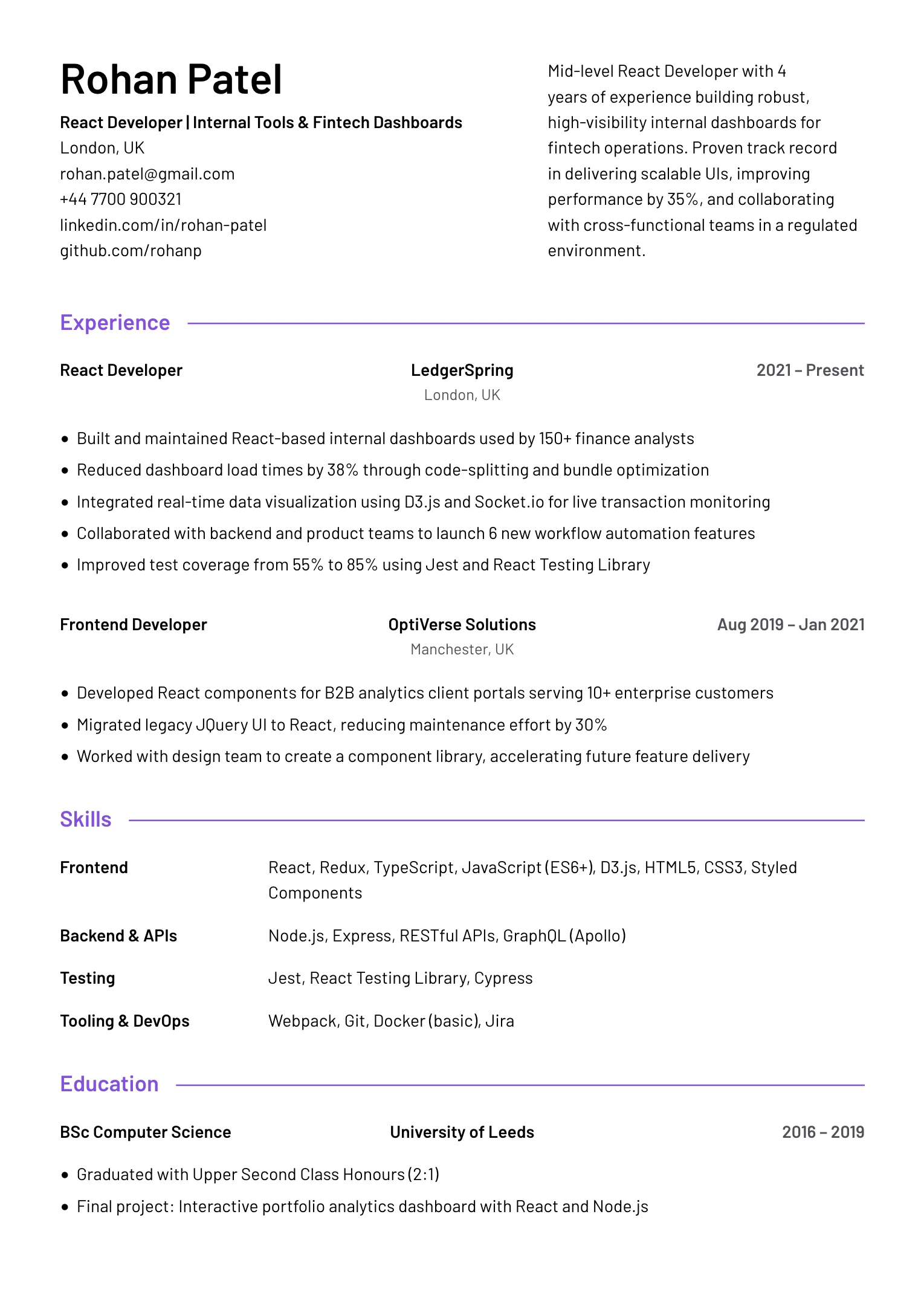
Mid-Level React Developer Resume Example
A mid-level React developer resume example with fintech dashboard experience. Ideal for SaaS, fintech, or internal tooling roles.
Why this works
- Clear metrics on dashboard performance
- Strong stack alignment for fintech tools
- Solid progression and role clarity
- Focused achievement-based bullet points
- Grouped technical skills for easy scanning
Mid-Level React Developer Resume: full text
Summary
Mid-level React Developer with 4 years of experience building robust, high-visibility internal dashboards for fintech operations. Proven track record in delivering scalable UIs, improving performance by 35%, and collaborating with cross-functional teams in a regulated environment.
Experience
React Developer
LedgerSpring, London, UK · 2021 – Present
- Built and maintained React-based internal dashboards used by 150+ finance analysts
- Reduced dashboard load times by 38% through code-splitting and bundle optimization
- Integrated real-time data visualization using D3.js and Socket.io for live transaction monitoring
- Collaborated with backend and product teams to launch 6 new workflow automation features
- Improved test coverage from 55% to 85% using Jest and React Testing Library
Frontend Developer
OptiVerse Solutions, Manchester, UK · Aug 2019 – Jan 2021
- Developed React components for B2B analytics client portals serving 10+ enterprise customers
- Migrated legacy JQuery UI to React, reducing maintenance effort by 30%
- Worked with design team to create a component library, accelerating future feature delivery
Skills
Frontend
React, Redux, TypeScript, JavaScript (ES6+), D3.js, HTML5, CSS3, Styled Components
Backend & APIs
Node.js, Express, RESTful APIs, GraphQL (Apollo)
Testing
Jest, React Testing Library, Cypress
Tooling & DevOps
Webpack, Git, Docker (basic), Jira
Education
BSc Computer Science
University of Leeds · 2016 – 2019
- Graduated with Upper Second Class Honours (2:1)
- Final project: Interactive portfolio analytics dashboard with React and Node.js
How to write a mid-level React developer resume
Hiring managers for mid-level React developer roles want clear evidence of hands-on experience building and optimizing production-grade UIs, especially in data-driven or regulated environments. Your resume should showcase measurable impact—such as performance improvements, increased test coverage, or successful feature launches—and detail your collaboration with cross-functional teams.
Structure your resume to highlight recent, relevant projects where you owned significant pieces of the React stack. Focus on technical achievements, the scale of your work (users, data, features), and the specific technologies used. Quantify improvements and results wherever possible to convey your value.
What skills should a React developer put on a resume?
A strong React developer resume should demonstrate technical depth across frontend frameworks, modern JavaScript, testing, and collaboration tooling. Emphasize your expertise in the React ecosystem, data visualization, and API integration, as well as your ability to work effectively in cross-functional teams.
- Frontend frameworks: React, Redux, TypeScript, JavaScript (ES6+), Styled Components, D3.js
- Testing: Jest, React Testing Library, Cypress
- API integration: RESTful APIs, GraphQL (Apollo), Socket.io
- Tooling: Webpack, Git, Docker (basic), Jira
- Collaboration: Agile methodologies, working with backend and product teams
React developer resume bullet point examples
Effective bullet points for mid-level React developers should highlight technical contributions, collaboration, and measurable outcomes. Use action-focused language and include results or improvements that demonstrate your impact.
- Implemented lazy loading for dashboard modules, improving time-to-interactive by 30% across key workflows.
- Collaborated with QA and design teams to launch an accessibility overhaul, boosting compliance with WCAG 2.1 standards.
- Refactored component state management using Redux Toolkit, reducing bug reports by 25% over two quarters.
- Developed custom D3.js charts for financial reporting, enabling real-time data filtering for 100+ end users.
- Automated CI testing for React components with Cypress, catching 15% more regressions pre-release.
Common mistakes on React developer resumes
Mid-level React developers often overlook the need to quantify their achievements or tailor their technical stack to the job. Avoid vague descriptions, outdated technologies, and underrepresenting your collaborative impact.
- Listing only basic React usage without advanced concepts like hooks, context, or performance optimization—add details on your depth.
- Ignoring measurable outcomes—include metrics such as performance gains, user adoption, or coverage improvements.
- Focusing solely on individual work—highlight teamwork, cross-functional collaboration, or mentorship roles.
- Neglecting to mention modern tooling (e.g., TypeScript, Redux, testing libraries)—update your stack to reflect current best practices.
Frequently asked questions
How long should a mid-level React developer resume be?
One page is ideal for mid-level React developers with up to 5 years' experience. Focus on your most recent and relevant roles, technical projects, and measurable achievements. Prioritize depth over listing every minor task or technology.
Should I include side projects or open source contributions as a React developer?
Yes, include side projects or open source work if they use technologies relevant to the role, such as React, Redux, or D3.js. Highlight your specific contributions, technical challenges solved, and any user or usage metrics if available.
How can I show leadership or impact as a mid-level React developer?
Demonstrate leadership by detailing times you improved processes (e.g., testing, performance), mentored peers, or collaborated across teams. Emphasize impact with metrics—like reduced load times, increased test coverage, or successful feature launches affecting key users.
Which keywords matter most for React developer resume screening?
Keywords like React, Redux, TypeScript, D3.js, REST APIs, GraphQL, Jest, React Testing Library, and performance optimization are important. Also include collaboration tools and Agile. Mirror terminology from the job description to ensure your resume passes applicant tracking systems (ATS).